
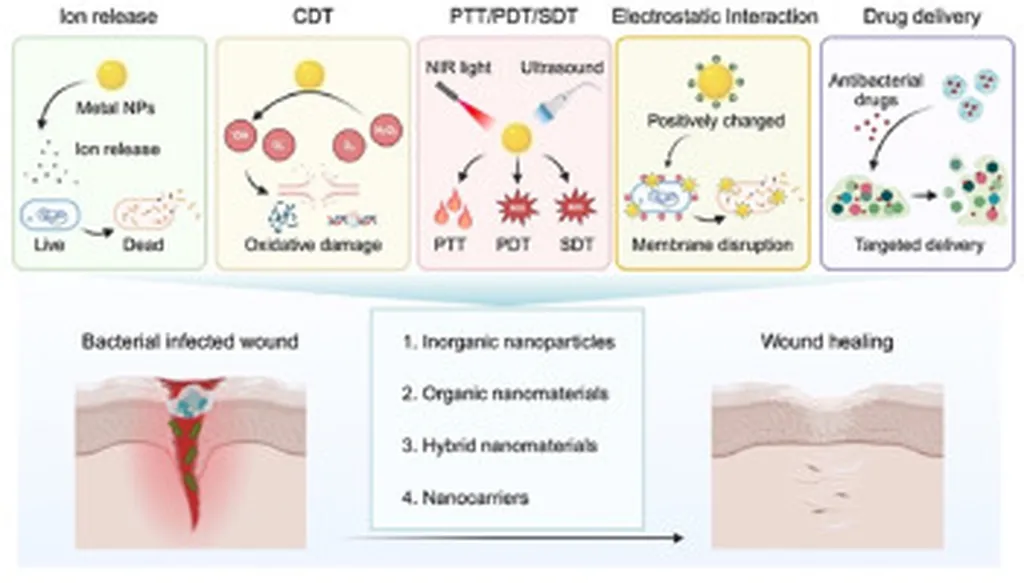
In the relentless battle against bacterial infections, a team of researchers led by Zhihui Zhang from the Department of Plastic Surgery at The First Affiliated Hospital of Xinjiang Medical University has developed a groundbreaking, multifunctional nanoplatform that could revolutionize wound treatment. This innovative approach, published in the journal *Materials & Design* (translated as *Materials & Design*), combines three powerful therapeutic modalities to tackle bacterial infections more effectively than ever before.
The study introduces a photo-responsive nanoplatform called TCO NPs, which integrates type I photodynamic therapy (PDT), photothermal therapy (PTT), and carbon monoxide (CO) gas-based therapy. This multifaceted treatment is triggered by near-infrared (NIR) laser irradiation, making it a precise and controlled method for eradicating bacterial pathogens.
“Our goal was to create a treatment that not only kills bacteria but also promotes tissue regeneration and reduces inflammation,” said Zhihui Zhang, the lead author of the study. “The overuse of antibiotics has led to resistance, making it crucial to develop alternative therapies. This nanoplatform offers a promising solution.”
The TCO NPs are composed of an NIR-absorbing photosensitizer (TDNH) and a metal-free CO donor (3-HF). When exposed to an 808 nm laser, the nanoplatform generates type I reactive oxygen species (ROS) and induces hyperthermia, effectively eliminating bacterial pathogens. The ROS produced by TDNH also triggers the controlled release of CO gas, which enhances antibacterial efficacy and modulates inflammatory responses to facilitate tissue regeneration.
In a full-thickness skin defect infection model, the nanoplatform demonstrated an impressive bacterial elimination rate exceeding 99% under 808 nm laser exposure. This remarkable efficacy underscores its potential as a reliable approach for CO-enhanced PTT and type I PDT in treating bacterial infected wounds.
The implications of this research are vast, particularly in the medical and healthcare sectors. The development of such advanced therapies could significantly reduce the reliance on antibiotics, addressing the growing concern of antibiotic resistance. Moreover, the precision and effectiveness of this treatment could lead to faster healing times and improved patient outcomes.
“This research opens up new avenues for the treatment of bacterial infections,” said a spokesperson from the medical community. “The combination of PDT, PTT, and CO gas therapy offers a multifaceted approach that could be applied to various medical fields, from wound care to surgical interventions.”
As the world continues to grapple with the challenges of antibiotic resistance, innovations like the TCO NPs nanoplatform provide a beacon of hope. The study, published in *Materials & Design*, represents a significant step forward in the fight against bacterial infections, offering a glimpse into the future of advanced wound care and regenerative medicine.
The commercial impacts of this research are also noteworthy. The development of such advanced therapies could lead to new products and treatments, creating opportunities for companies in the medical and healthcare sectors. The precision and effectiveness of this treatment could also reduce healthcare costs by minimizing the need for prolonged treatments and hospital stays.
In conclusion, the research led by Zhihui Zhang and his team at The First Affiliated Hospital of Xinjiang Medical University highlights the potential of combining multiple therapeutic modalities to create a powerful and effective treatment for bacterial infections. This innovative approach not only addresses the pressing issue of antibiotic resistance but also paves the way for future developments in the field of wound care and regenerative medicine.