
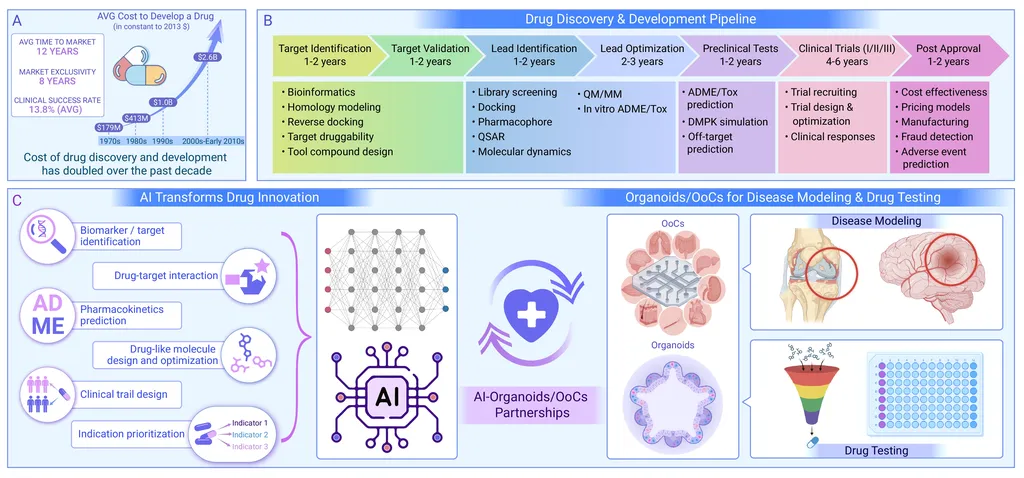
In the rapidly evolving intersection of artificial intelligence and biomedical research, a groundbreaking review published in the journal *Bioactive Materials* (translated from Chinese as “生物活性材料”) introduces a novel concept that could revolutionize drug discovery and personalized medicine: Artificial Intelligence Virtual Organoids, or AIVOs. Often referred to as “silicon organoids,” these digital twins of physical organoids promise to bridge the gap between in vitro experiments and clinical practice, offering a scalable, reproducible, and high-throughput platform for in silico experiments.
Led by Long Bai, a researcher at the Institute of Translational Medicine at Shanghai University, the review outlines how AIVOs can overcome the limitations of traditional organoid platforms, such as batch variability, sparse longitudinal data, and scalability issues. “AIVOs fuse multimodal and longitudinal measurements into universal state representations,” Bai explains, “allowing us to emulate assays and perturbations with virtual instruments constrained by biophysical priors.” This fusion of data and computational modeling enables a more comprehensive understanding of biological processes and disease mechanisms.
The potential applications of AIVOs are vast, spanning drug screening, dosing design, disease subtyping, and resistance mapping. By integrating with organoid-on-chip systems and clinical decision support tools, AIVOs could significantly accelerate the development of precise therapies and regulatory translation. “Virtual organoids provide a silicon-grounded, transparent, and reproducible bridge between physical organoids and clinical practice,” Bai notes, highlighting the transformative potential of this technology.
For the energy sector, the implications are equally profound. The ability to perform high-throughput in silico experiments without added experimental burden could lead to more efficient and cost-effective drug development processes. This, in turn, could open new avenues for collaboration between the pharmaceutical and energy industries, particularly in the development of biofuels and other energy-related applications.
However, the path to widespread adoption of AIVOs is not without challenges. Bai and his colleagues emphasize the need for high-quality longitudinal data, scalable computation, and model reduction techniques. Additionally, issues of interpretability, causal reasoning, and governance—addressing privacy, safety, and fairness—must be carefully considered.
As the field of biomedical research continues to evolve, the introduction of AIVOs represents a significant step forward in our ability to model and understand complex biological systems. By harnessing the power of artificial intelligence and computational modeling, researchers like Long Bai are paving the way for a future where personalized medicine and precise therapies are not just aspirations but realities. The review published in *Bioactive Materials* serves as a testament to the innovative spirit driving this transformative research, offering a glimpse into the exciting possibilities that lie ahead.