
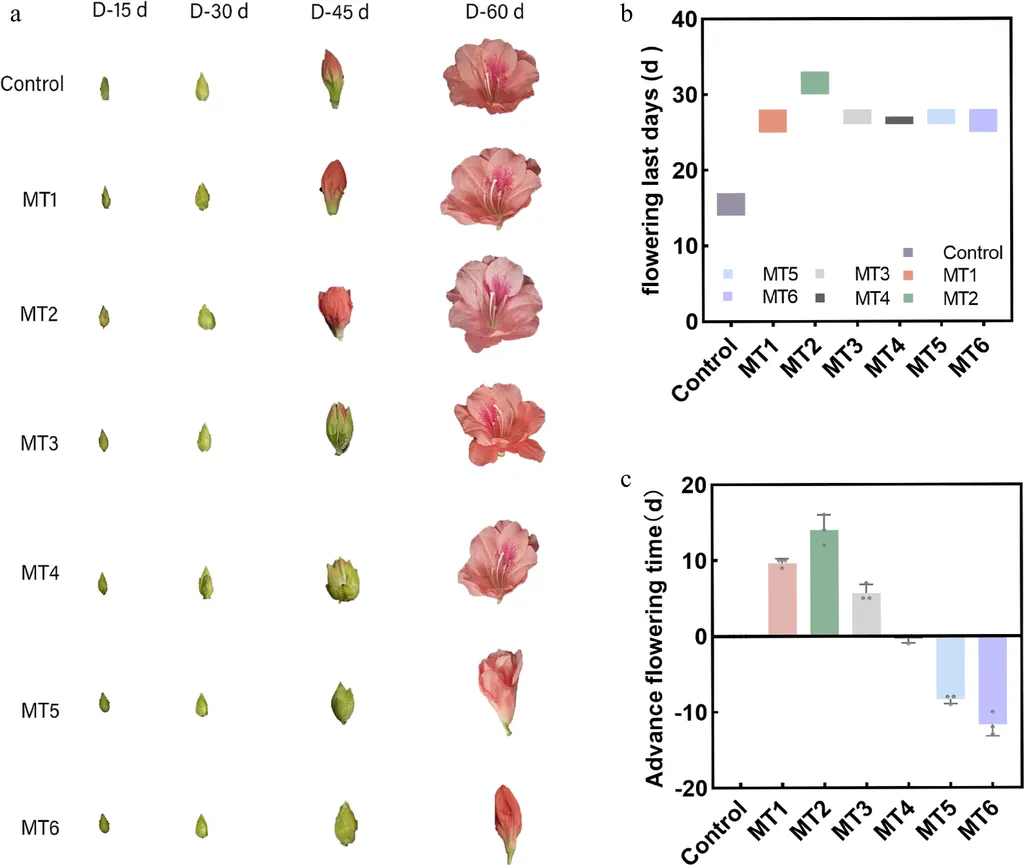
In the world of ornamental horticulture, a groundbreaking study led by Linlan Fu from the Jiangsu Urban and Rural Construction Vocational College in Changzhou, China, has shed new light on the effects of phytomelatonin (PMT) on azaleas, particularly the cultivar Rhododendron maculiferum ‘Pink Round Cluster’. Published in the journal *Ornamental Plant Research* (translated from its original Chinese title), the research delves into how varying concentrations of exogenous PMT influence flowering and physiological changes in azaleas, offering promising insights for the floriculture industry.
Fu and her team discovered that PMT has a concentration-dependent effect on azalea flowering. Low concentrations of PMT, particularly at 300 μmol·L−1, significantly promoted flowering, while higher concentrations delayed it. This finding is crucial for commercial growers who aim to control the flowering duration and timing of their crops. “The sequence of flowering was quite striking,” Fu explained. “We observed that the optimal concentration for promoting flowering was 300 μmol·L−1, which resulted in the longest flowering duration of 32 days.”
The study also revealed that PMT treatments enhanced endogenous nutrient levels in the plants. Low-concentration PMT treatments increased the levels of gibberellic acid (GA3), indole-3-acetic acid (IAA), and zeatin riboside (ZR) in flower buds during the early treatment phase, while significantly decreasing abscisic acid (ABA) levels. High-concentration PMT treatments, on the other hand, increased GA3, IAA, and ZR levels in the later treatment phase. These hormonal changes are key to understanding how PMT can be used to manipulate flowering times and durations.
The implications for the floriculture industry are substantial. By carefully controlling the concentration of PMT applied to azaleas, growers can optimize flowering periods to meet market demands, potentially increasing the commercial value of their crops. “This research provides a theoretical foundation for regulating the flowering duration in azaleas using exogenous PMT,” Fu noted. “It opens up new possibilities for application in the floriculture industry.”
As the industry continues to evolve, the findings from this study could pave the way for more precise and effective plant growth regulation techniques. The ability to manipulate flowering times and durations not only enhances the aesthetic appeal of ornamental plants but also has significant economic benefits for growers and retailers alike. With further research, the potential applications of PMT in other plant species could be explored, broadening the scope of its use in agriculture and horticulture.
In summary, Fu’s research offers a compelling glimpse into the future of plant growth regulation, highlighting the potential of PMT as a powerful tool for optimizing flowering in azaleas. As the industry continues to seek innovative solutions to enhance crop quality and marketability, this study provides valuable insights that could shape future developments in the field.