
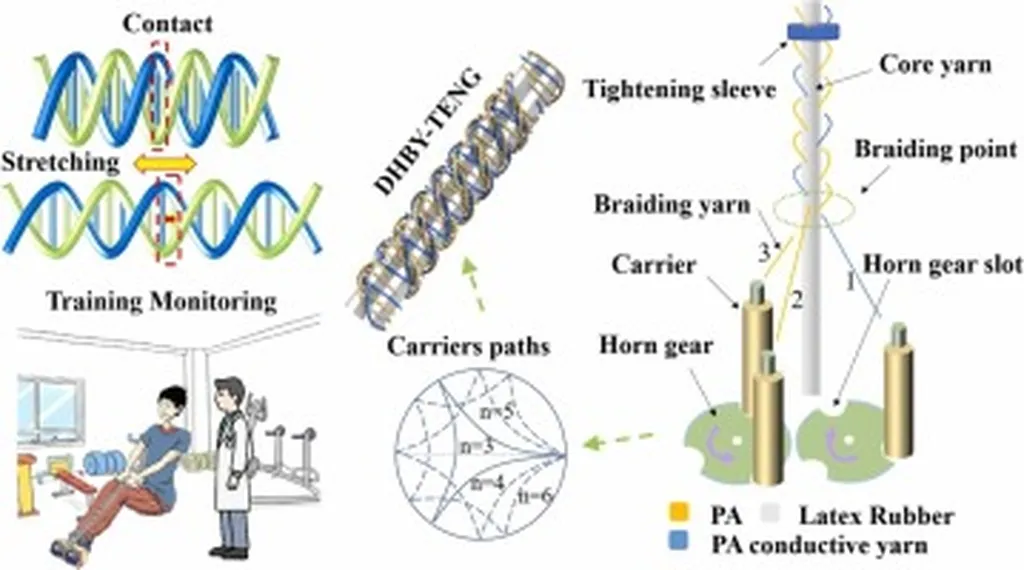
In the realm of advanced materials and composite structures, a groundbreaking study led by Ning Yang of Jiangnan University in Wuxi, China, is set to revolutionize the way we model and analyze braided structures. Published in the Journal of Engineered Fibers and Fabrics, which translates to the Journal of Engineered Fibers and Textiles, this research introduces a novel matrix transformation framework that promises to enhance the design and application of braided composites, particularly in the energy sector.
Braided structures are widely used in various industries due to their strength, flexibility, and durability. However, modeling these structures at the fiber level has been a complex and challenging task. Yang’s research addresses this challenge by proposing a unified approach that uses quadratic B-spline curves to generate 3D fiber paths. This method ensures excellent computability and parameter scalability, making it convenient, flexible, and efficient for a wide range of applications.
One of the key innovations in this study is the introduction of a fiber distribution function. This function accurately describes the braided yarn configuration, accounting for fiber count, internal or external transfer, and distribution in the cross-section of the bundle. “This function is a game-changer,” says Yang. “It allows us to model the intricate details of braided structures with unprecedented accuracy.”
The study also introduces twisting parameters such as twisting degree, twist angle, and twist direction. These parameters significantly improve the texture and 3D visualization effect of twisted braided yarn, making the models more realistic and useful for practical applications. The framework can model net-shaped or curved tubular fiber-level braided structures using tape and strand units, with parameter optimization enhancing computational efficiency and geometric adaptability.
The implications of this research for the energy sector are profound. Braided composites are used in various energy applications, from wind turbine blades to oil and gas pipelines. The ability to accurately model and analyze these structures at the fiber level can lead to significant improvements in their design and performance. For instance, more accurate models can help engineers optimize the strength and durability of wind turbine blades, leading to more efficient and reliable renewable energy systems.
Moreover, the framework’s ability to achieve fully parametric modeling and flexible changes of 2D circular braided fabrics can provide excellent structural continuity. This is crucial for fiber-scale mechanical analysis and can support digital modeling and multi-scale performance prediction of braided composites. “Our framework provides an effective architectural support for the digital modeling and multi-scale performance prediction of braided composites,” explains Yang. “This can significantly enhance the design and application of these materials in various industries, including the energy sector.”
The simulation results demonstrate the framework’s ability to accurately simulate various braided configurations, making it a valuable tool for researchers and engineers. As the energy sector continues to evolve, the demand for advanced materials and composites is expected to grow. This research provides a solid foundation for future developments in this field, paving the way for more innovative and efficient energy solutions.
In conclusion, Ning Yang’s research represents a significant step forward in the modeling and analysis of braided structures. Its potential applications in the energy sector are vast, and its impact on the design and performance of advanced materials is likely to be profound. As we continue to explore and harness the power of these materials, this research will undoubtedly play a crucial role in shaping the future of the energy industry.