
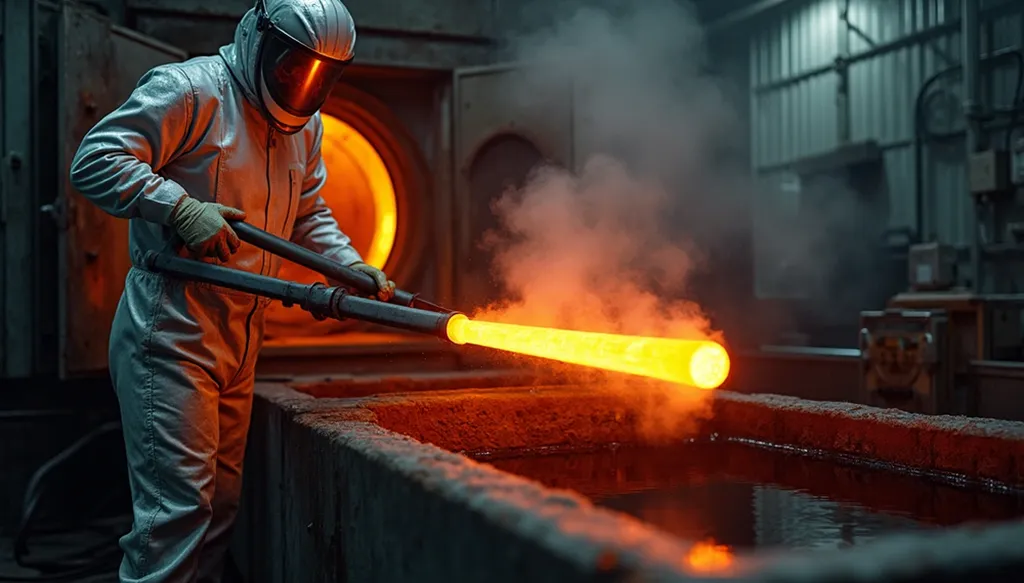
In the relentless pursuit of optimizing industrial processes, researchers have turned their attention to the behavior of AISI 4340 steel under extreme conditions, with potentially significant implications for the energy sector. A recent study, led by Japheth Obiko from the Department of Chemical, Metallurgical and Material Engineering, has delved into the hot deformation of this widely used steel, offering insights that could revolutionize large-scale forging processes.
The research, published in the journal *Advances in Materials Science and Engineering* (which translates to *Advances in Materials Science and Engineering* in English), employed numerical simulations using Deform 3D software to investigate the steel’s behavior at temperatures ranging from 1000°C to 1150°C and strain rates from 3 to 12 s⁻¹. This approach allowed the team to create processing maps and constitutive models that characterize the deformation mechanisms and flow stress behavior of the material.
Obiko explained, “Our study reveals that dynamic recrystallization is the dominant softening mechanism during the hot deformation of AISI 4340 steel. This is crucial for understanding how the material behaves under extreme conditions and for optimizing industrial forging processes.”
The findings indicate that flow stress increases with decreasing temperature at constant strain rates, peaking at approximately 0.4 true strain. The stress exponent and activation energy were determined to be 7.5 and 458.25 kJ/mol, respectively. The model developed by the team demonstrates high predictive accuracy, with an R² value of 0.997, an average absolute relative error of 0.779, and a Pearson’s value of 0.999.
One of the most significant outcomes of the study is the identification of optimal processing conditions for AISI 4340 steel. Processing maps revealed a peak efficiency of 36% at a strain rate of 12 s⁻¹ between 1000°C and 1010°C. These findings are poised to have a substantial impact on the energy sector, where large-scale forging of structural components is a common requirement.
Obiko elaborated, “By understanding the optimal processing conditions, industries can enhance the efficiency and quality of their forging processes. This not only reduces costs but also improves the performance and reliability of the final products.”
The implications of this research extend beyond the immediate findings. As the energy sector continues to evolve, the demand for high-performance materials and efficient manufacturing processes will only grow. The insights gained from this study could pave the way for future developments in material science and engineering, driving innovation and progress in the field.
In summary, the work of Obiko and his team represents a significant step forward in the understanding of AISI 4340 steel behavior under hot deformation. Their findings offer valuable guidance for industrial applications and highlight the importance of advanced numerical simulations in optimizing manufacturing processes. As the energy sector continues to push the boundaries of what is possible, research like this will be instrumental in shaping the future of material science and engineering.