
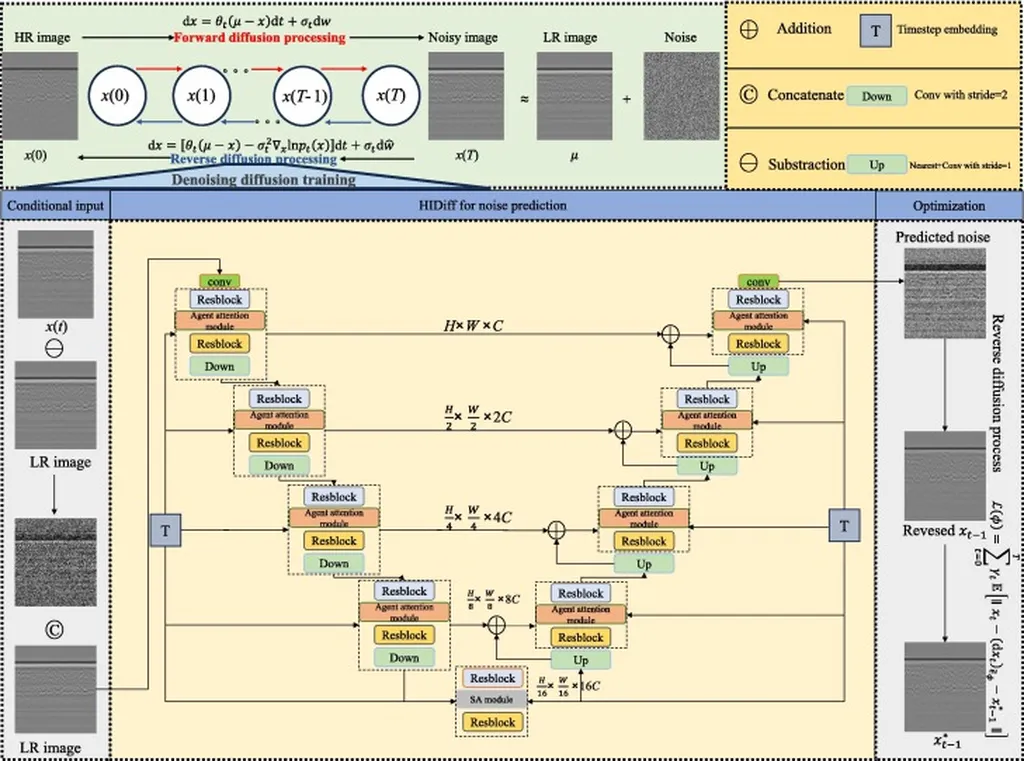
In the bustling urban landscapes where construction and energy infrastructure intersect, a new breakthrough in ground-penetrating radar (GPR) technology is set to revolutionize how we detect and map underground utilities. Researchers, led by Xiaosong Tang from the School of Artificial Intelligence at China University of Mining and Technology, have developed a cutting-edge algorithm named GPR-HIDiff. This innovation promises to enhance the clarity and accuracy of subsurface imaging, a critical component for construction and energy sector projects.
Ground-penetrating radar is a non-invasive technology that uses radar pulses to image the subsurface. However, the effectiveness of GPR is often hampered by high-amplitude horizontal interference, which can obscure vital data. Traditional methods for mitigating this interference have been labor-intensive and lack the flexibility needed for diverse urban environments. Tang and his team have addressed these challenges by leveraging a diffusion model, a type of machine learning algorithm that has shown remarkable success in various fields.
GPR-HIDiff employs a sophisticated architecture that includes ResBlocks and agent attention modules, which work together to suppress horizontal artifacts while preserving the integrity of target hyperbolic contours. “The key innovation here is the integration of a diffusion model with spatial and agent attention mechanisms,” Tang explains. “This allows us to achieve a level of precision and adaptability that was previously unattainable.”
The research team also constructed a standardized dataset comprising real-world measured samples and finite difference time domain simulation samples of urban road models. This hybrid dataset was crucial for validating the effectiveness of GPR-HIDiff. “By training our model on a diverse set of data, we ensure that it can perform reliably in various real-world scenarios,” Tang adds.
The implications for the energy sector are profound. Accurate subsurface imaging is essential for planning and executing energy infrastructure projects, from laying pipelines to installing underground power lines. GPR-HIDiff’s ability to suppress interference and preserve target details can significantly reduce the risk of costly errors and delays. “This technology has the potential to streamline construction workflows and enhance safety,” Tang notes.
The study, published in the journal ‘Underground Space’ (which translates to ‘Underground Space’ in English), demonstrates that GPR-HIDiff outperforms both traditional methods and state-of-the-art deep learning models. Its success in both simulated and real-world test samples underscores its robustness and reliability.
As the energy sector continues to evolve, the need for advanced subsurface detection technologies will only grow. GPR-HIDiff represents a significant step forward in this domain, offering a powerful tool for high-resolution imaging and target detection. With further development and integration into intelligent construction workflows, this technology could reshape the future of urban infrastructure development.