
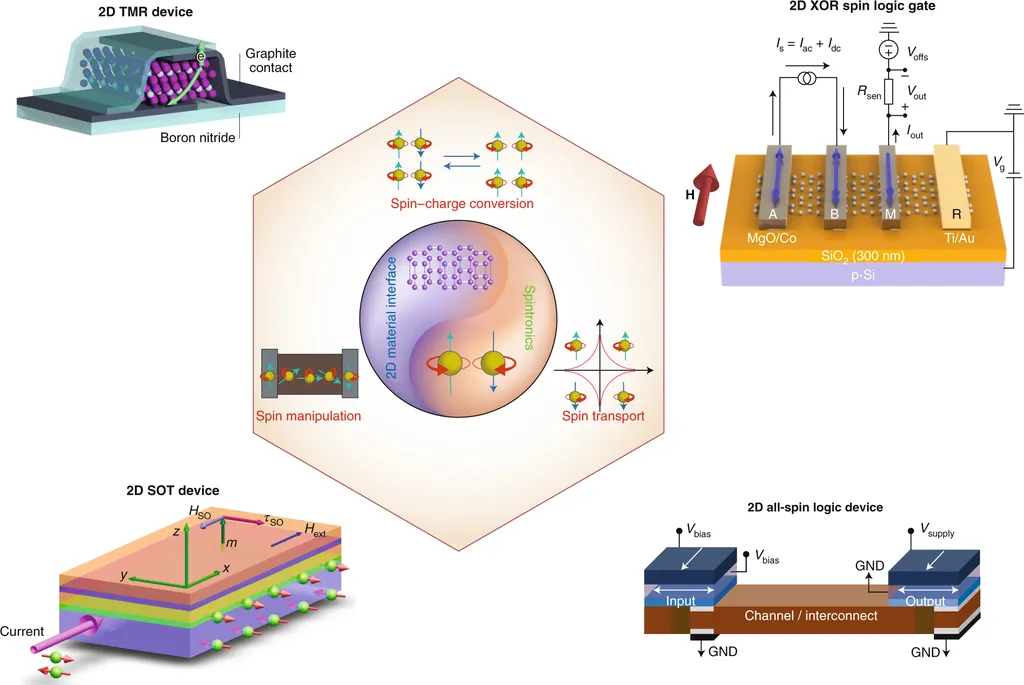
In the heart of China’s Sichuan province, researchers are unlocking the potential of a technology that could revolutionize the energy efficiency of our electronic devices. Ibrahim Adamu Tasiu, a lead author from the School of Electronic and Information Engineering at China West Normal University, has been at the forefront of this research, exploring the promising field of spintronics. This emerging technology harnesses the quantum property of electron spin, offering a more efficient alternative to traditional charge-based electronics.
Spintronics, or spin transport electronics, utilizes the intrinsic spin of electrons to store and process information. Unlike conventional electronics, which rely on the movement of electrical charges, spintronics manipulates the spin state of electrons, leading to significant energy savings. Tasiu and his team have been investigating the integration of advanced materials, such as topological insulators and two-dimensional ferromagnets, to stabilize magnetic structures known as skyrmions. These tiny, swirling magnetic disturbances hold the key to high-density, nonvolatile memory storage.
One of the most compelling aspects of this research is its potential impact on the energy sector. “Spintronic devices can operate at ultra-low energy consumption levels,” Tasiu explains. “This could lead to significant energy savings in data centers and other high-performance computing environments, which are responsible for a substantial portion of global energy consumption.”
The team’s findings, published in the Journal of Science: Advanced Materials and Devices (translated from Chinese as 《先进材料与器件科学》), demonstrate that spintronic neuromorphic systems can achieve an impressive 20 trillion operations per second per watt (TOP/s/w). This performance surpasses traditional artificial intelligence accelerators, offering a more energy-efficient solution for tasks like pattern recognition and data analysis.
Moreover, the research highlights the potential of spin qubits for quantum computing. With a fidelity of 99.9%, these spin-based quantum bits offer a scalable pathway to quantum computing, which could revolutionize fields ranging from cryptography to drug discovery.
The commercial implications of this research are vast. As our world becomes increasingly connected, the demand for energy-efficient computing solutions continues to grow. Spintronics could play a pivotal role in meeting this demand, enabling the development of high-performance, low-power devices that are compatible with existing semiconductor technologies.
Looking ahead, Tasiu and his team are focusing on three-dimensional magnetic tunnel junction stacking, aiming for densities exceeding 1 terabit per cubic millimeter (Tb/mm³). They are also exploring defect-tolerant materials to facilitate large-scale commercialization. As this research continues to advance, it is poised to shape the future of the energy sector, offering innovative solutions to some of our most pressing challenges.
In the words of Tasiu, “Spintronics is not just about improving existing technologies; it’s about reimagining what’s possible. By harnessing the power of electron spin, we can create a more sustainable and efficient future.”