
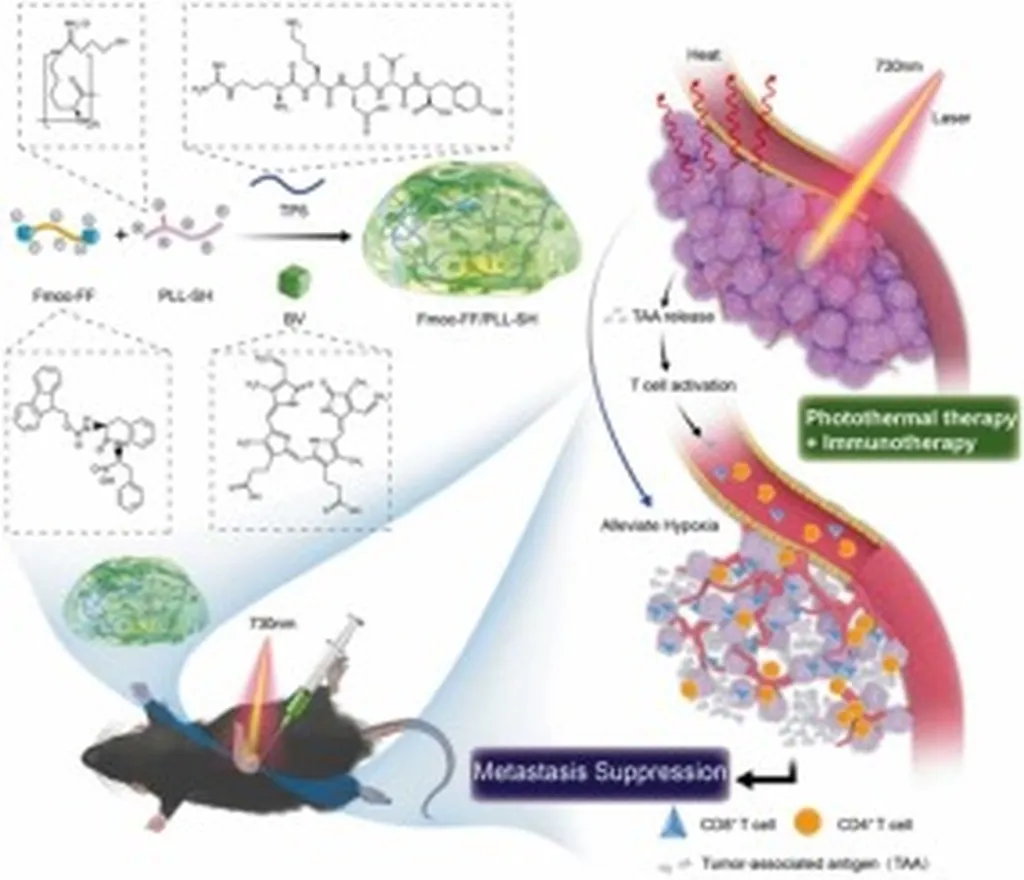
In the relentless pursuit of effective treatments for one of the most lethal cancers, pancreatic ductal adenocarcinoma (PDAC), a novel approach is emerging that combines the precision of photothermal therapy with the body’s own immune response. This innovative strategy, known as photothermal immunotherapy, is gaining traction in the scientific community, with recent advances outlined in a comprehensive review published in *MedComm – Biomaterials and Applications* (which translates to *Medical Communications – Biomaterials and Applications*).
Pancreatic cancer remains a formidable challenge, with traditional treatments like surgery, chemotherapy, and radiotherapy often falling short of delivering satisfactory outcomes. However, the field of immunotherapy has shown promising early-stage advancements, including mRNA vaccines, immune checkpoint inhibitors, and chimeric antigen receptor T-cells (CAR-T). Despite these advancements, significant improvements in clinical prognosis for PDAC have yet to be achieved.
Enter photothermal therapy (PTT), a technique that uses light-absorbing materials to convert light into heat, selectively targeting and destroying tumor cells. But PTT’s potential doesn’t stop at localized thermal ablation. As Zan Hu, lead author of the review and a researcher at the Department of Biomedical Engineering, Institute of Basic Medical Sciences Chinese Academy of Medical Sciences & Peking Union Medical College, explains, “PTT can also promote an antitumor immune response under appropriate conditions. When tumor cells are destroyed, they release damage-associated molecular patterns (DAMPs) and tumor-associated antigens (TAAs), which can activate antigen-presenting cells (APCs) and stimulate T cell infiltration to attack the tumor cells.”
This dual action of PTT—directly killing tumor cells and stimulating the immune system—presents a unique opportunity for enhancing the efficacy of cancer treatments. The review highlights the latest research progress in this evolving field, discussing how photothermal immunotherapy could potentially overcome some of the limitations of current treatments.
The implications of this research extend beyond the immediate medical applications. As the understanding of photothermal immunotherapy grows, it could pave the way for new commercial opportunities in the energy sector, particularly in the development of advanced materials and technologies for targeted thermal therapies. The integration of immunotherapy with other treatment modalities could also drive innovation in medical device manufacturing and biotechnology.
While the prospects are promising, challenges remain. The review emphasizes the need for further research to optimize the conditions for photothermal immunotherapy and to translate these findings into clinical practice. As Hu notes, “The application prospects and challenges for photothermal immunotherapy in pancreatic cancer treatment are significant. We need to continue exploring and refining these strategies to improve patient outcomes.”
In the quest to conquer pancreatic cancer, photothermal immunotherapy offers a beacon of hope. By harnessing the power of light and the body’s immune system, this innovative approach could revolutionize cancer treatment and open new avenues for commercial and technological advancements. The journey is far from over, but with each new discovery, the path forward becomes clearer.