
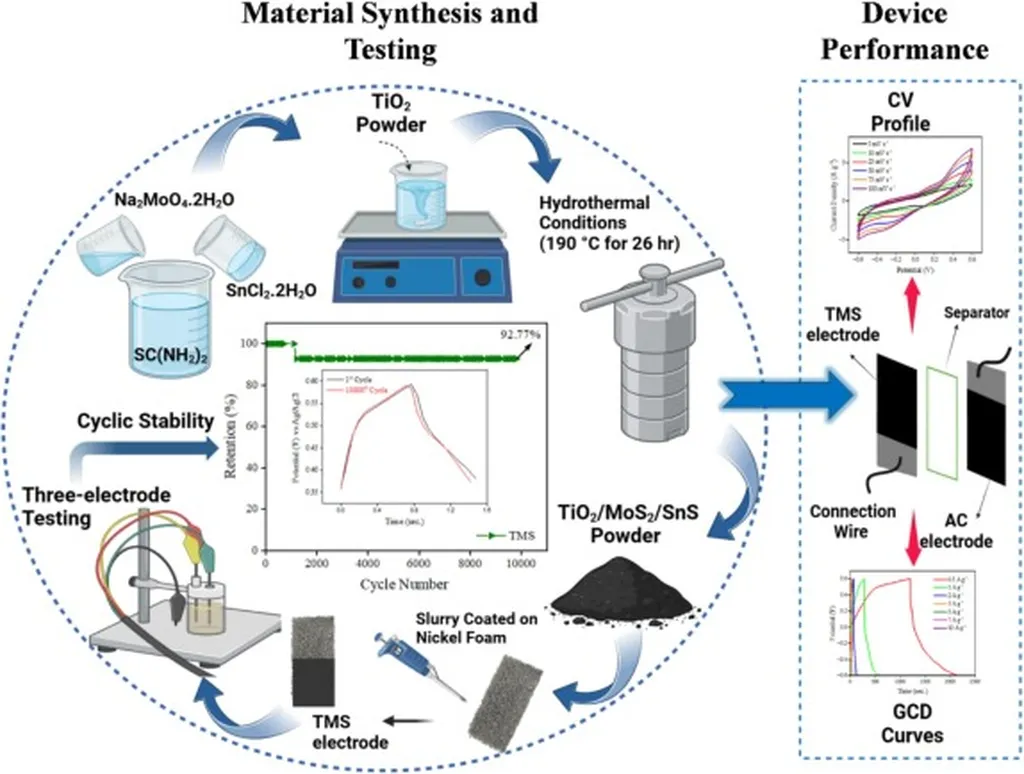
In the quest for enhanced lubrication performance, a team of researchers led by Baikun Huang from the Department of Automotive Engineering at Yeungnam University in South Korea has made a significant stride. Their work, published in the journal *Materials Research Express* (which translates to *Materials Research Express* in English), explores the potential of TiO2/MoS2 nanocomposite additives to revolutionize lubricant technology, with profound implications for the energy sector.
The study delves into the synthesis and application of TiO2/MoS2 nanocomposites as additives in lubricating oils, aiming to optimize their tribological and rheological properties. Tribology, the science of interacting surfaces in relative motion, is crucial for reducing friction and wear in mechanical systems, thereby enhancing energy efficiency and longevity of components.
Huang and his team employed a cost-effective synthesis route involving thermal annealing and ultrasonication to create these nanocomposites. The researchers then mixed these hybrids with base oil, using TritonX-100 to improve dispersion stability. The tribological performance of the modified oils was evaluated using a ball-on-disc configuration, testing various ratios of TiO2 to MoS2 (1:2, 2:1, and 1:3) and different additive concentrations (0.05–1.0 wt%).
The results were promising. A 2:1 ratio of TiO2 to MoS2, with a concentration of 0.7 wt%, achieved the lowest coefficient of friction, marking a 44% improvement over the base oil. This significant reduction in friction could translate to substantial energy savings and reduced wear and tear in industrial applications.
“The potential energy savings from using these optimized lubricants are enormous,” Huang explained. “This could lead to more efficient machinery, reduced maintenance costs, and a longer lifespan for critical components in the energy sector.”
The structural and morphological characteristics of the nanocomposites were analyzed using X-ray powder diffraction, transmission electron microscopy, and scanning electron microscopy. These analyses provided insights into the wear and damage characteristics of the nanocomposites, further validating their effectiveness.
This research not only highlights the importance of nanocomposite additives in enhancing lubricant performance but also demonstrates a low-cost synthesis route that could be easily scaled up for industrial applications. The findings could pave the way for more efficient and durable lubricants, benefiting various industries, particularly the energy sector, where reducing friction and wear is paramount.
As the world continues to seek ways to improve energy efficiency and reduce environmental impact, innovations in lubricant technology play a crucial role. Huang’s research offers a glimpse into the future of tribology, where advanced materials and smart additives could redefine the boundaries of what is possible.
“This is just the beginning,” Huang noted. “We are excited about the potential of these nanocomposites and the impact they could have on the energy sector and beyond.”
In an era where every drop of energy counts, the quest for better lubricants is more critical than ever. Huang’s work serves as a testament to the power of innovation in addressing real-world challenges, driving progress, and shaping the future of industrial efficiency.