
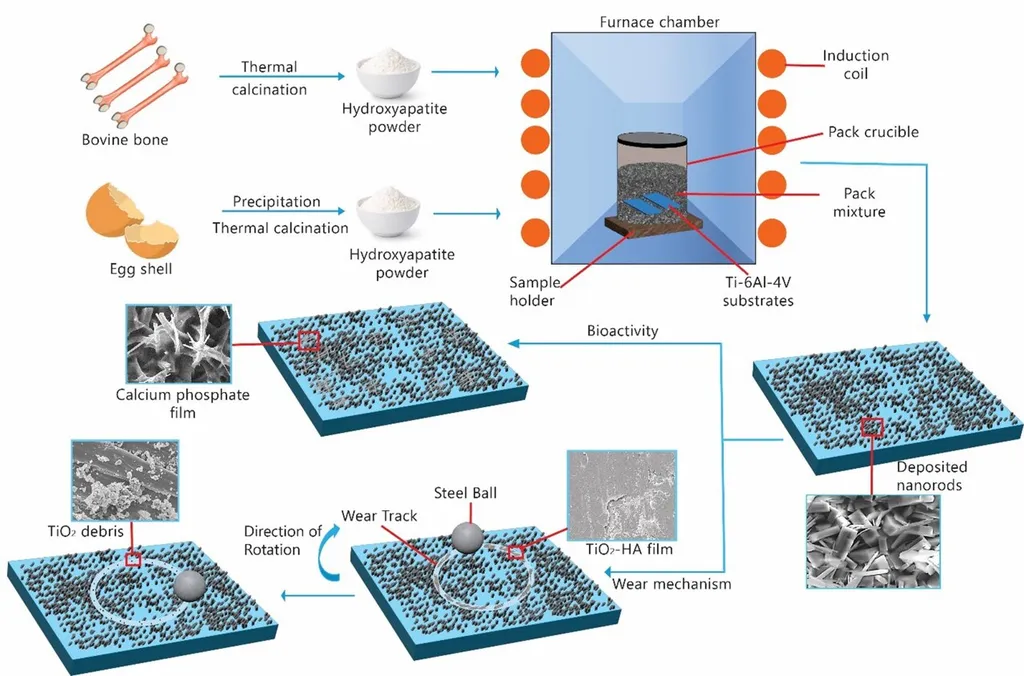
In the ever-evolving world of biomedical materials, a groundbreaking study has emerged from the labs of Afyon Kocatepe University in Turkey, led by Ismail Yıldız from the Machinery and Metal Technologies department. The research, published in the journal *Materials Research Express* (translated as “Materials Research Express”), focuses on enhancing the surface and corrosion properties of titanium sheets using electrophoretic deposition (EPD) of nano graphene and boron-doped hydroxyapatite (HA) coatings. This innovation could significantly impact the biomedical field, particularly in implant materials, by improving their biological performance and corrosion resistance.
Titanium and its alloys have long been favored in the biomedical industry due to their excellent mechanical properties and biocompatibility. However, the quest to enhance their biological performance, especially in implant materials, has led researchers to explore advanced coating techniques. Yıldız and his team investigated the electrophoretic deposition of HA-based composite materials, which are crucial in bone tissue engineering.
The study involved coating titanium sheets with HA, HA with 1 wt% boron (HA-B), and HA with 1 wt% graphene (HA-Gr) at varying voltages of 30, 60, and 90 V. The researchers systematically analyzed the influence of key process parameters, including applied voltage, deposition time, and solid loading, through morphological, structural, and chemical bonding analyses.
One of the most significant findings was the superior corrosion properties of HA-B-coated surfaces compared to other coatings. “The addition of boron to hydroxyapatite coatings has shown remarkable improvements in corrosion resistance, which is crucial for the longevity of implant materials,” Yıldız explained. This discovery could lead to more durable and reliable biomedical implants, reducing the need for frequent surgeries and improving patient outcomes.
The study also revealed that pure HA coatings exhibited hydrophobic behavior, while the addition of boron and graphene imparted hydrophilic characteristics. This finding is particularly important as hydrophilic surfaces are known to enhance cell adhesion and proliferation, which are critical factors in the success of bone implants.
The coatings’ thicknesses ranged from 31.25 μm to 97.5 μm, with the highest quality coatings obtained at 90 V. X-ray diffraction analysis confirmed the presence of HA, Ti, and TiO2 phases, while Raman analyses indicated high crystallinity in HA samples. The presence of graphene in HA-Gr composites was confirmed by the D and G bands, and the weakening and broadening of the ν1 (PO4) band in HA-B samples highlighted the successful incorporation of boron.
This research not only advances our understanding of coating technologies but also opens new avenues for developing advanced biomedical materials. As Yıldız noted, “The potential applications of these coatings extend beyond biomedical implants. They could also be used in other industries where corrosion resistance and surface properties are critical, such as the energy sector.”
The energy sector, in particular, could benefit from these advancements. Improved corrosion resistance and surface properties could lead to more efficient and durable energy storage and conversion devices, such as batteries and fuel cells. This could have a profound impact on the development of renewable energy technologies, making them more reliable and cost-effective.
In conclusion, the research led by Ismail Yıldız and his team at Afyon Kocatepe University represents a significant step forward in the field of biomedical materials. The enhanced surface and corrosion properties of titanium sheets achieved through electrophoretic deposition of nano graphene and boron-doped hydroxyapatite coatings hold promise for a wide range of applications, from biomedical implants to energy storage devices. As the world continues to seek innovative solutions to complex challenges, this research offers a glimpse into the future of advanced materials and their potential to transform industries.