
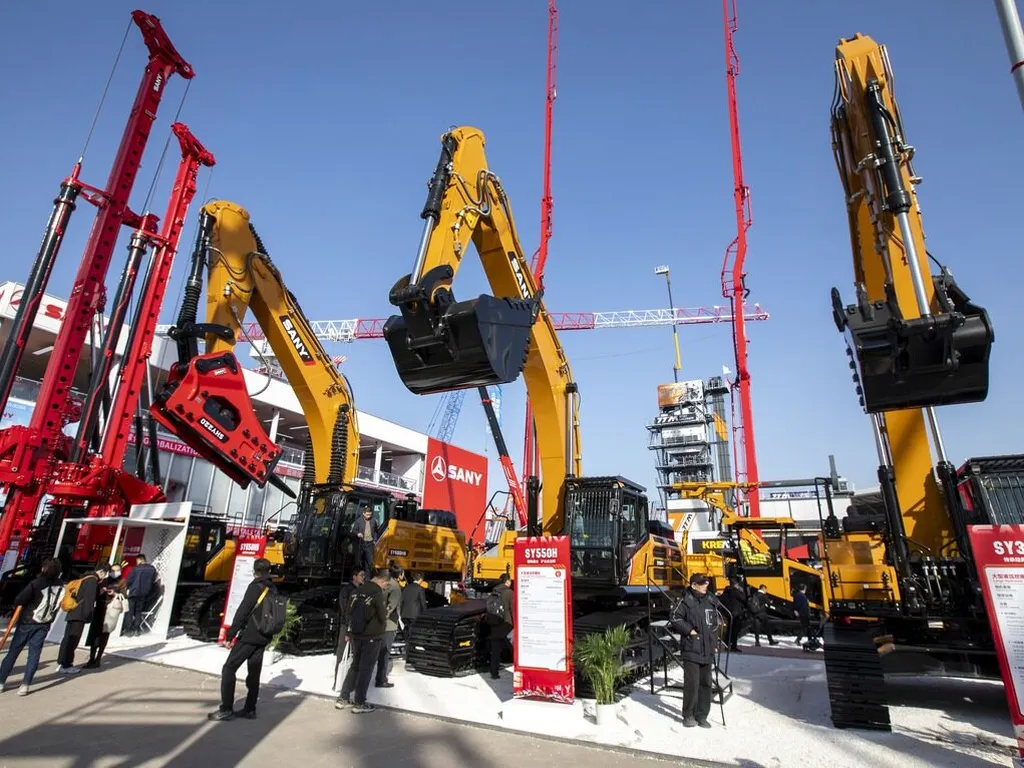
In the realm of construction machinery, preventing equipment from toppling over is a critical safety concern, and precise calculations of support reaction forces are key to achieving this. However, traditional methods often fall short, yielding ambiguous solutions and failing to account for the complex interactions between machinery and the ground. Enter Tianyu Wang, a researcher from the School of Mechanics and Aerospace Engineering at Dalian University of Technology in Liaoning, China, who has proposed a novel approach to tackle this very challenge.
Wang’s research, published in the journal *Advances in Mechanical Engineering* (which translates to *Advances in Mechanical Engineering* in English), focuses on the intricate relationship between reaction forces and penetration depth, a dynamic often overlooked in conventional engineering practices. “The primary challenges reside in statically indeterminate force distributions and the indeterminacy of ground-contact states at support points,” Wang explains. “Conventional methods often lead to ambiguous solutions, and while finite element methods (FEM) can be used, they are computationally intensive for this purpose.”
The crux of Wang’s method lies in its ability to correlate micro-displacements of support structures with reaction forces, formulating equilibrium equations that significantly enhance both accuracy and computational efficiency. This innovation is particularly relevant for the energy sector, where heavy machinery is a staple. “By providing initial values and the corresponding Jacobian matrix, our method offers a more precise and efficient way to analyze the stability of construction machinery,” Wang adds.
The implications of this research are far-reaching. In an industry where safety and efficiency are paramount, having a more accurate and efficient method to calculate support reaction forces can lead to better-designed machinery, reduced downtime, and ultimately, cost savings. “This method offers an innovative idea for resolving statically indeterminate problems while simultaneously determining contact states—a critical factor in construction machinery overturn analysis,” Wang notes.
The research paper includes several examples that verify the correctness of the proposed method, providing a solid foundation for its application in real-world scenarios. As the energy sector continues to evolve, the need for more precise and efficient engineering solutions will only grow. Wang’s work represents a significant step forward in this direction, offering a glimpse into the future of construction machinery design and safety.
In the words of Wang, “This research not only addresses a long-standing challenge in the field but also opens up new avenues for further exploration and development.” As the industry continues to push the boundaries of what’s possible, innovations like these will be crucial in shaping the future of construction and energy sectors.