
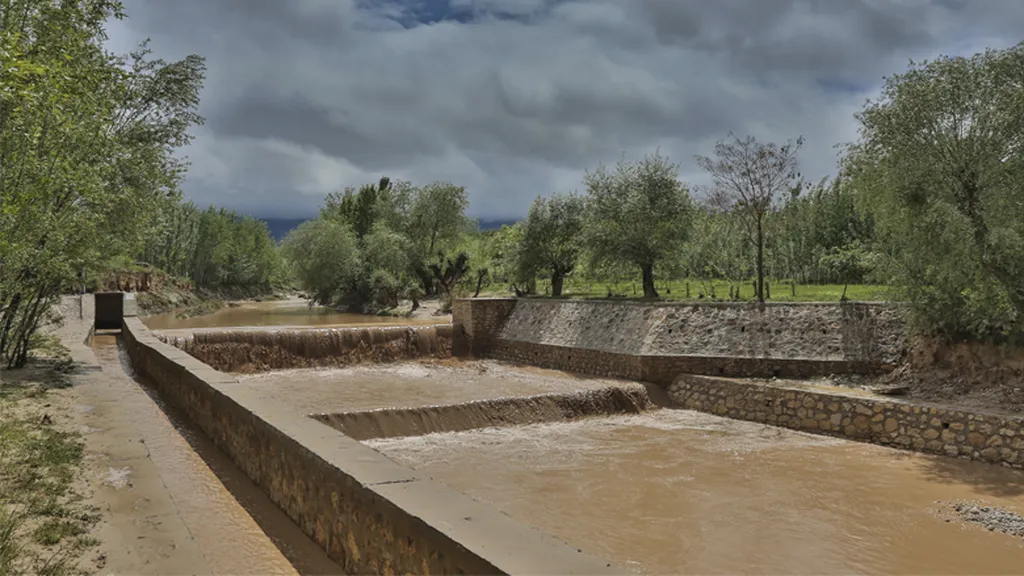
In the arid expanses of Southern Kazakhstan, where water is a precious commodity, irrigation canals are the lifeblood of agriculture. Yet, these vital conduits face formidable challenges, from cracking and frost heave to abrasive wear and aggressive environments. These issues lead to significant water loss, sometimes exceeding 20-25% of the supplied volume—a critical concern in a region characterized by water scarcity and extreme climate.
Enter Alibek М. Imanov, a researcher from Abylkas Saginov Karaganda Technical University, who has developed a modified concrete (MC) mixture that could revolutionize the durability and impermeability of hydraulic structures. Published in the journal *Нанотехнологии в строительстве* (Nanotechnologies in Construction), Imanov’s research presents a promising solution to the persistent problems plaguing irrigation canals.
The modified concrete incorporates a blend of mineral and chemical additives, including silica fume, fly ash, an air-entraining agent, and hydrophobizing components. This innovative mixture has been rigorously tested against conventional concrete (CC) using relevant GOST standards, revealing substantial performance enhancements.
“Our modified concrete demonstrates a significant increase in compressive strength, up to 55 MPa, and splitting tensile strength, up to 4.6 MPa,” Imanov explains. “Moreover, it shows a remarkable improvement in frost resistance, water impermeability, abrasion resistance, and sulfate resistance.”
The results are impressive: a 45% increase in frost resistance, a 50% improvement in water impermeability, a 26.9% enhancement in abrasion resistance, and an 11.5% increase in sulfate resistance. Microstructural analysis confirms these improvements, revealing a densified cement matrix with reduced macroporosity and an increased content of low-basic C–S–H phases.
The implications for the energy and agricultural sectors are profound. By extending the service life of canal linings by 30-40% and reducing filtration losses by up to 20%, this modified concrete can significantly enhance water-use efficiency. This is particularly crucial in regions facing water scarcity and aggressive environmental impacts.
Imanov’s research not only addresses immediate challenges but also paves the way for future developments in the field. As water scarcity becomes an increasingly global concern, the need for durable, efficient hydraulic structures will only grow. This modified concrete offers a promising solution, ensuring the resilience of irrigation systems and the sustainability of agricultural production.
In a world grappling with climate change and resource depletion, innovations like Imanov’s modified concrete are not just scientific advancements—they are beacons of hope for a more sustainable future. As the research continues to gain traction, it has the potential to reshape the landscape of hydraulic engineering, offering a blueprint for enhanced operational reliability and water conservation.