
In the realm of underground construction, shield tunnels are the unsung heroes, facilitating the smooth operation of metro systems and other critical infrastructure. However, these tunnels are not invincible. A new study, published in the journal *Advances in Civil Engineering* (translated from Chinese as *Advances in Civil Engineering*), sheds light on the domino effect that can occur when local damage strikes these vital structures. The research, led by Sijia Han from the Department of Civil Engineering, offers a fresh perspective on how to safeguard our subterranean networks.
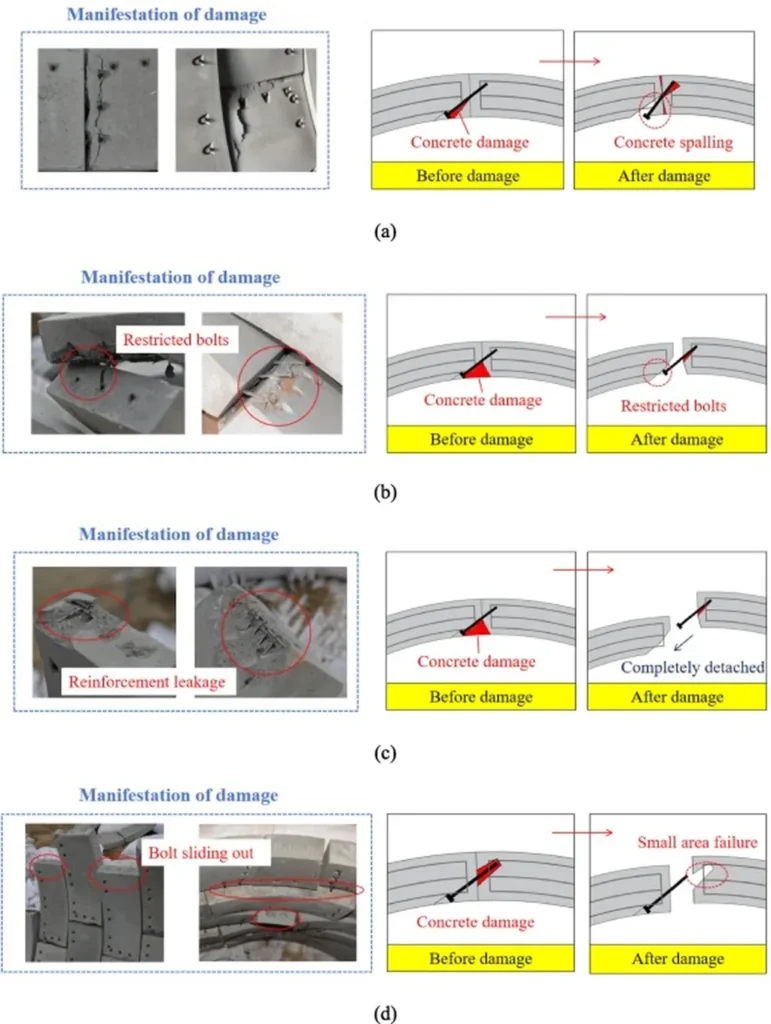
Han and her team delved into the mechanical response of adjacent ring structures following local damage in shield tunnels. Using a sophisticated numerical model based on the coupled Eulerian–Lagrangian (CEL) method, they simulated tunnel local failures to understand the stress states of nearby structures. The findings are eye-opening. “An unloading zone and soil arching effect are spontaneously formed in the vicinity of the local failure region following tunnel structural damage,” Han explains. This phenomenon induces torsional deformation in segments close to the damaged area, leading to insufficient torsional and shear bearing capacity.
The study also reveals that the impact of local failure on adjacent ring structures is not uniform. “The closer the failure location is to the tunnel crown, the more pronounced the adverse effects on the adjacent ring, while the impact attenuates significantly on the opposite side of the tunnel,” Han notes. This positional dependence is crucial for engineers to understand, as it directly influences the safety and longevity of shield tunnels.
For the energy sector, the implications are substantial. Shield tunnels are often used for transporting energy resources and housing critical infrastructure. Local failures, if not properly addressed, can lead to progressive collapse, posing severe threats to operational safety and economic stability. Han’s research underscores the importance of targeted reinforcement measures for adjacent rings in potential local failure-prone zones. The study proposes three specific recommendations to guide engineering practice, offering a roadmap for enhancing the resilience of shield tunnels.
As we push the boundaries of underground construction, this research serves as a timely reminder of the need for vigilance and innovation. By understanding the mechanical responses of shield tunnels to local damage, engineers can better design and maintain these structures, ensuring the smooth operation of our subterranean networks. Han’s work is a beacon in this endeavor, illuminating the path forward for the construction industry.