
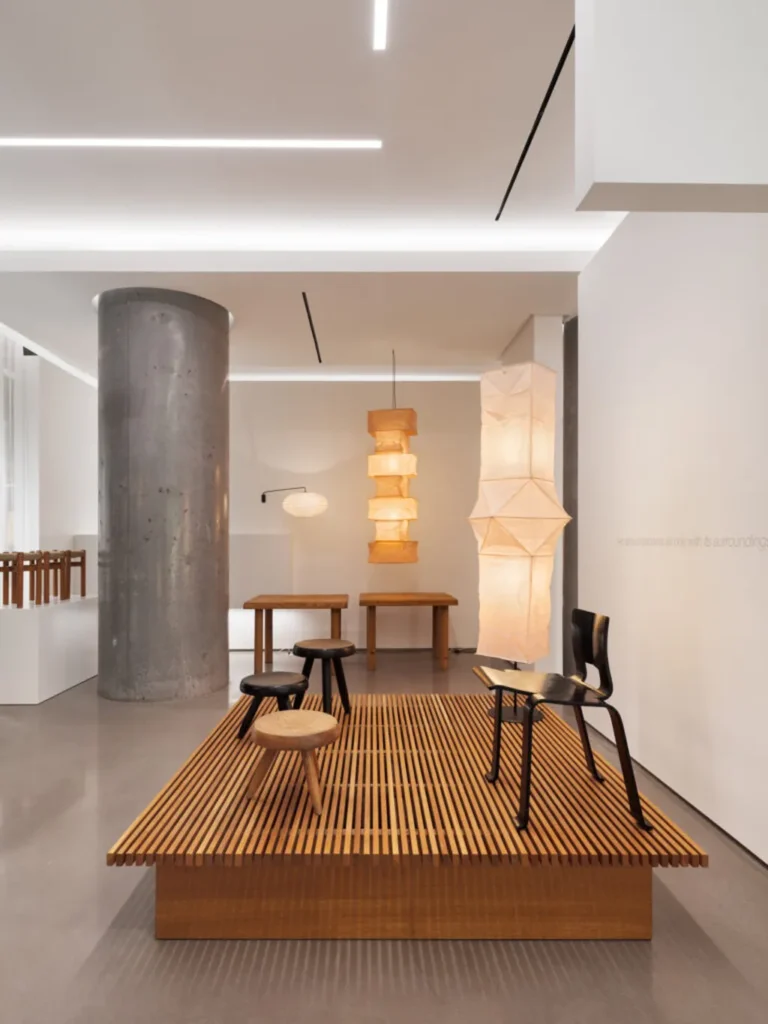
In the heart of World War II, as the world was engulfed in turmoil, a quiet yet profound cultural exchange was taking place in Japan. French architect and designer Charlotte Perriand, known for her innovative work with Le Corbusier, was invited to Japan to teach export crafts. Her year-long stay culminated in the “Selection, Tradition, Creation” Exhibition in 1941, a fusion of French modernism and Japanese folklore that continues to resonate in design circles today.
Shoichiro Sendai, a researcher from the Institute of Environmental Systems Science at Shimane University, has delved into the archives to unravel the concept behind this seminal exhibition. Sendai’s research, published in the Japan Architectural Review (Jikken Kokusai Kenchiku Kaishi), reveals how Perriand interpreted Japanese “folklore” through her own design lens, creating a unique blend of East and West.
Perriand’s works exhibited were not mere imitations of Japanese folk crafts. Instead, they were variations on prototypes she had developed in France. “She made a shift in materials and techniques, a reduction in the size of furniture, and a transfer of patterns,” Sendai explains. By incorporating bamboo, straw materials, and weaving techniques, Perriand created pieces that were distinctly Japanese in their essence yet unmistakably modern in their form.
This interpretation of Japanese folklore was not just a reflection of Perriand’s understanding of Japan but also a reflection on her own design methods. It was a dialogue between two cultures, a conversation that transcended the boundaries of time and space. As Sendai notes, “It was both a way of understanding Japan and a reflection on her own design methods.”
The commercial impact of this cultural exchange is still felt today. Perriand’s work in Japan paved the way for a greater appreciation of Japanese design in the West, influencing a generation of designers and architects. Her use of natural materials and traditional techniques also anticipated the sustainable design movement, which has become increasingly important in the energy sector.
As we grapple with the challenges of climate change and resource depletion, Perriand’s work reminds us of the importance of looking to the past for inspiration. By blending tradition with innovation, we can create designs that are not only aesthetically pleasing but also environmentally sustainable. Sendai’s research sheds light on this process, providing valuable insights for designers and architects today.
In an era where the energy sector is increasingly turning to sustainable and innovative solutions, Perriand’s work serves as a reminder of the power of cultural exchange and the importance of looking to the past for inspiration. As we strive to create a more sustainable future, we can look to Perriand’s work as a guiding light, a beacon of creativity and innovation that continues to inspire and influence the design world today.