
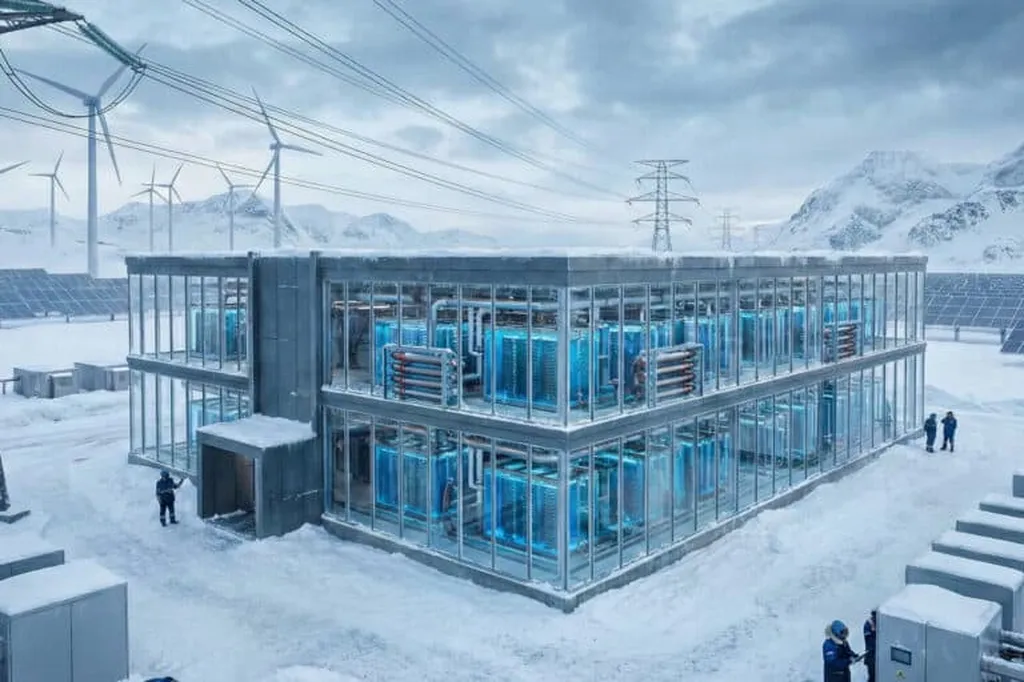
In the heart of Taiyuan, a groundbreaking demonstration project is pushing the boundaries of data center cooling technology, offering a glimpse into the future of high-density computing. Led by Wang Xinyi and a team of researchers, a novel two-phase microchannel self-driven air-cooling system has been put to the test, with promising results that could reshape the energy landscape of data centers worldwide.
The team, whose affiliation is not disclosed, has tackled a pressing challenge in the data center industry: the cooling demands of high-density cabinets. As intelligent computing continues to advance, the power density of a single cabinet has surged, posing significant cooling hurdles. “The traditional air-cooling systems often fall short in handling the heat dissipation requirements of these high-power-density configurations,” explains Wang Xinyi, the lead author of the study published in ‘Zhileng xuebao’, which translates to ‘Heat Engineering Journal’.
The researchers developed a cabinet-level air-cooling system that leverages a two-phase microchannel design, allowing it to achieve an impressive heat-transfer capacity of 40 kW. When applied to a high-density cabinet in Taiyuan, the system demonstrated its mettle, effectively managing the heat dissipation needs of a cabinet with a power density of 30 kW under full-load conditions.
But the team didn’t stop there. They constructed a heat-transfer process model based on their experimental data, exploring the potential of future two-phase self-driven air-cooled terminals under various external conditions. Their findings suggest that, with the right parameters—such as maintaining a return air temperature of 35°C, a chilled water source temperature of 12°C, and a wind speed of 5 m/s—the air-cooled terminal could achieve a heat dissipation capacity of up to 65.2 kW.
The implications for the energy sector are substantial. As data centers strive to increase their computing power while minimizing energy consumption, innovative cooling solutions like this one could play a pivotal role. “This study offers new possibilities and technical support for existing air-cooled data centers to further enhance their computing power,” says Wang Xinyi.
The research not only validates the effectiveness of the two-phase microchannel self-driven air-cooling system but also provides a roadmap for future developments in the field. As data centers continue to evolve, the need for efficient, high-capacity cooling solutions will only grow. This study, published in ‘Zhileng xuebao’, serves as a beacon, guiding the industry towards a future where high-density computing and energy efficiency go hand in hand.