
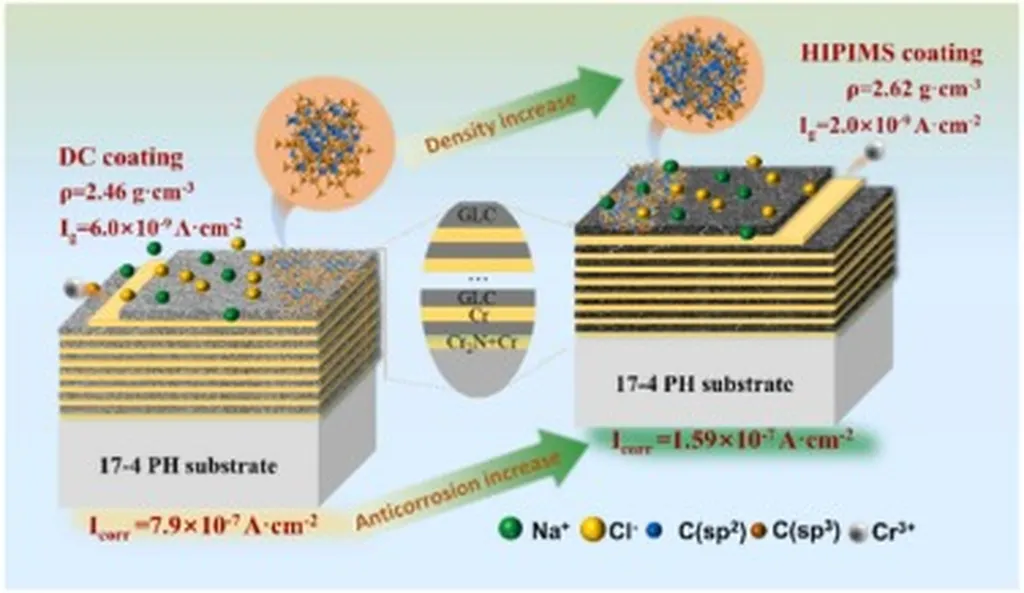
In the relentless battle against corrosion and wear in marine environments, researchers have made a significant stride with a new approach to coating technology. Dr. Xiaohui Zhou, affiliated with the State Key Laboratory of Advanced Marine Materials at the Ningbo Institute of Materials Technology and Engineering, Chinese Academy of Sciences, and ShanghaiTech University, has led a study that could revolutionize the durability of materials used in offshore and marine applications.
The team’s focus was on chromium nitride (CrN) coatings, which are known for their excellent wear resistance. However, the challenge has always been to enhance their performance in corrosive environments, such as seawater. The solution? High Power Impulse Magnetron Sputtering (HiPIMS), a advanced coating deposition technique that allows for precise control over the coating’s microstructure.
By varying the ratio of argon to nitrogen gas during the deposition process, the researchers were able to tailor the microstructure of the CrN coatings. “We found that the coating prepared with an Ar:N2 ratio of 5:2 exhibited the best tribocorrosion performance,” Dr. Zhou explained. This coating demonstrated the lowest wear depth and wear rate, thanks to its denser dual-phase structure composed of CrN and Cr2N.
The implications for the energy sector are substantial. Offshore wind turbines, oil and gas platforms, and other marine structures are constantly exposed to harsh environmental conditions. The development of coatings that can withstand both wear and corrosion could significantly extend the lifespan of these structures, reducing maintenance costs and improving safety.
Moreover, the ability to control the microstructure of the coatings opens up new possibilities for customization. As Dr. Zhou noted, “This research not only provides a new method for preparing high-performance coatings but also offers a deeper understanding of the relationship between microstructure and tribocorrosion behavior.”
The study, published in the journal Corrosion Communications (translated from the original Chinese title), is a testament to the power of advanced materials science in addressing real-world challenges. As the energy sector continues to push the boundaries of exploration and exploitation in marine environments, innovations like these will be crucial in ensuring the longevity and reliability of critical infrastructure.
In the words of Dr. Zhou, “This is just the beginning. We are excited about the potential of HiPIMS-deposited CrxN coatings and the possibilities they offer for future developments in the field.” With such promising research on the horizon, the future of marine materials science looks brighter than ever.