
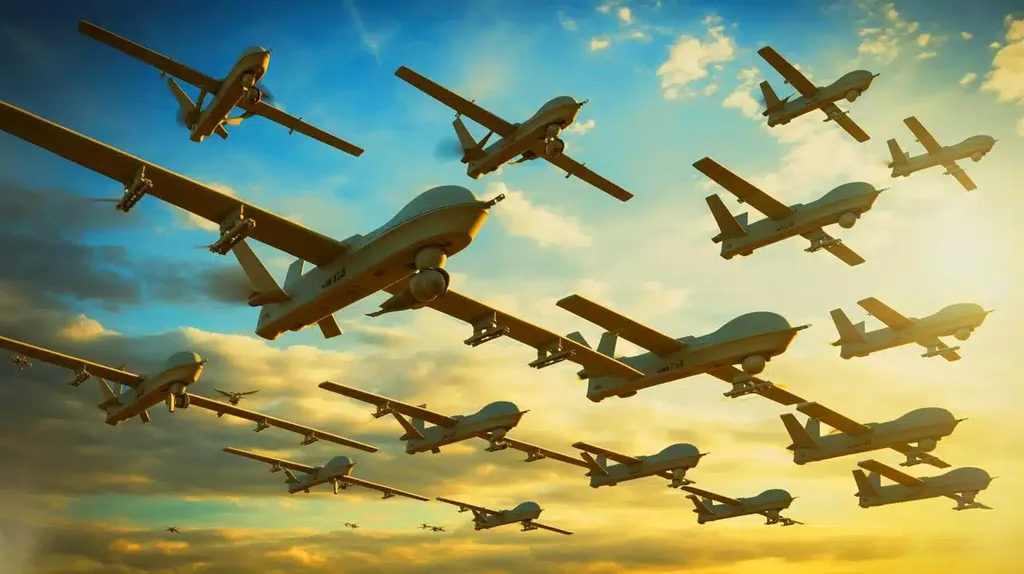
In the rapidly evolving world of unmanned aerial vehicles (UAVs), a groundbreaking study led by Maxim Yena of the National Aerospace University “Kharkiv Aviation Institute” is set to redefine how we manage and route UAV fleets in dynamic air environments. Published in the journal *Сучасний стан наукових досліджень та технологій в промисловості* (Modern State of Scientific Research and Technologies in Industry), Yena’s research introduces an integrated simulation model that combines swarm control methods, adaptive PID control, and adaptive routing algorithms to enhance the safety, optimality, and efficiency of UAV operations.
The study addresses the complex challenges of controlling UAV swarms in dynamically changing air conditions, a critical issue for industries relying on UAVs for tasks such as infrastructure inspection, environmental monitoring, and energy sector applications. “The goal was to develop a system that not only ensures the safe and efficient movement of UAVs but also adapts in real-time to changing conditions,” Yena explained. This adaptability is crucial for the energy sector, where UAVs are increasingly used for inspecting power lines, pipelines, and wind turbines, often in environments with unpredictable weather and air traffic.
Yena’s integrated model leverages adaptive PID control for dynamic regulation of UAV movement trajectories, ensuring flight accuracy and stability. Swarm control algorithms, inspired by boids-type methods, facilitate synchronization of movement and collision avoidance within UAV groups. The model also employs nonlinear optimization techniques to minimize collision risks, energy consumption, and flight time, all while constructing a graph-theoretic model of the airspace for effective route planning and situation forecasting.
The results of the simulation experiments are promising. The integrated model demonstrated a significant reduction in the average positioning error and collision avoidance among UAVs. Notably, the study reported a 50% increase in the reward of agents, a 50% increase in the successful completion of episodes, and a 10% reduction in agent errors on the way to the goal. These improvements highlight the potential for the model to enhance the efficiency and reliability of UAV operations in real-world scenarios.
For the energy sector, the implications are substantial. UAVs equipped with this advanced control and routing system could perform inspections more efficiently and safely, reducing downtime and maintenance costs. The ability to adapt to changing conditions in real-time could also improve the accuracy of data collection, leading to better decision-making and resource management.
As the energy sector continues to embrace UAV technology, Yena’s research offers a glimpse into the future of UAV operations. The integrated simulation model developed by Yena and his team represents a significant step forward in the field, paving the way for more sophisticated and reliable UAV applications. The study’s findings, published in *Сучасний стан наукових досліджень та технологій в промисловості*, underscore the importance of adaptive algorithms and graph-theoretic models in achieving high forecasting accuracy and risk minimization.
In an industry where precision and efficiency are paramount, Yena’s work is poised to shape the next generation of UAV technology, offering a robust solution for the complex challenges of modern airspace management.