
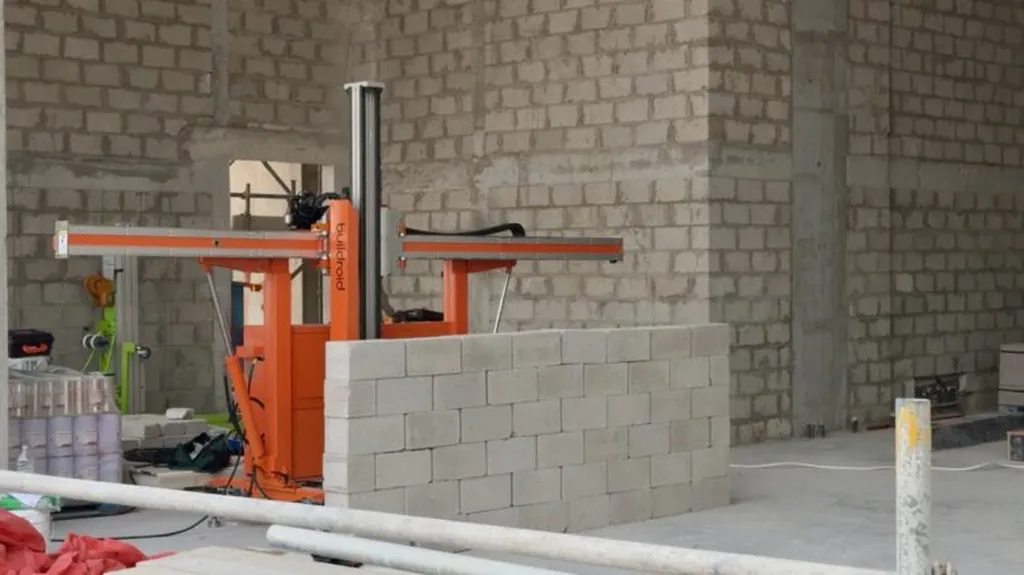
In a groundbreaking study published in the journal *Discover Civil Engineering* (translated from Russian as “Discover Civil Engineering”), researchers have unveiled a novel approach to creating sustainable, high-performance waterproof concrete blocks. The research, led by Shubham Rai from the Department of Civil Engineering at the Institute of Engineering and Technology, demonstrates how industrial by-products and machine learning can revolutionize the construction industry, offering significant environmental and economic benefits.
The study addresses a critical challenge in the construction sector: the environmental impact of conventional concrete. Traditional concrete production is resource-intensive and contributes significantly to carbon emissions. Rai and his team explored the use of industrial steel slag as a partial replacement for natural fine aggregate, combined with polypropylene fibers (PPF) and high-density polyethylene (HDPE) sheets to enhance waterproofing and durability.
“Our goal was to develop a sustainable alternative that doesn’t compromise on performance,” said Rai. “By integrating industrial by-products and advanced materials, we aimed to create concrete blocks that are not only eco-friendly but also meet the high standards required in the construction industry.”
The experimental program yielded impressive results. Mix C1, which replaced 10% of the natural fine aggregate with steel slag, achieved a 28-day compressive strength of 49.67 MPa, a 16.2% improvement over the control mix. Mix C2, with 15% slag replacement, demonstrated optimal durability and sustainability, reducing water absorption by 23.5% and the Global Warming Potential (GWP) by 10.9%.
The study also employed advanced machine learning models, specifically Random Forest and XGBoost, to predict the performance of the concrete blocks. The XGBoost model proved to be the most effective, achieving R2 values consistently above 0.90 for all target metrics, with a peak R2 of 0.96 for compressive strength. “The integration of machine learning allowed us to optimize the mix designs and predict performance with high accuracy,” explained Rai. “This predictive capability is crucial for scaling up the production of these eco-efficient concrete blocks.”
The implications of this research are far-reaching. By utilizing industrial by-products and advanced materials, the construction industry can significantly reduce its environmental footprint while maintaining high performance standards. The use of machine learning models further enhances the efficiency and accuracy of the production process, making it a viable option for large-scale implementation.
“This research provides a holistic framework for producing eco-efficient, high-performance concrete blocks,” said Rai. “It offers a sustainable approach toward reducing the ecological footprint of the construction sector, which is crucial for meeting global environmental goals.”
As the construction industry continues to seek sustainable solutions, the findings of this study offer a promising path forward. By embracing innovative materials and technologies, the sector can achieve both environmental and economic benefits, paving the way for a more sustainable future.