
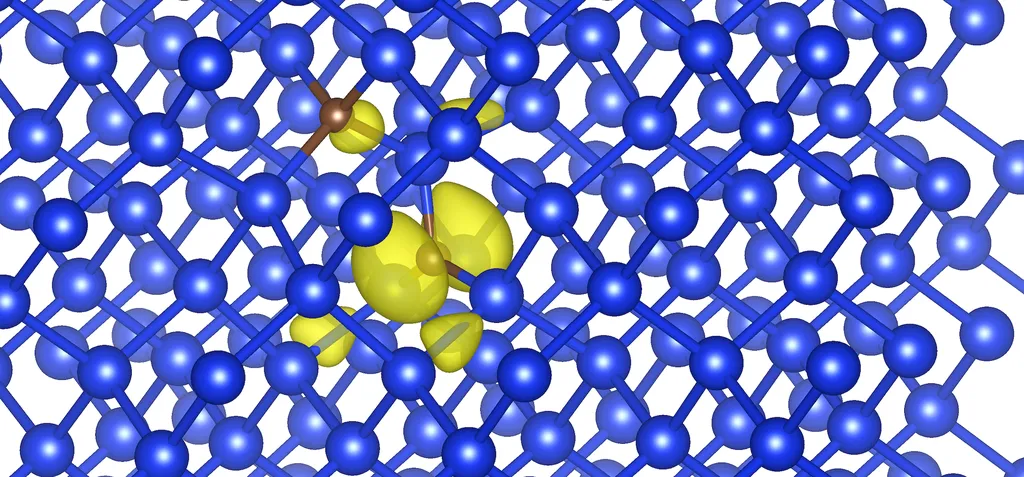
In the quest to harness the power of quantum technologies, researchers have long grappled with the challenges posed by defects in solid-state materials. These defects, often referred to as two-level systems (TLS), can significantly impact the coherence and performance of quantum devices. A recent study led by Qianxu Wang from Dartmouth College’s Department of Physics and Astronomy and Thayer School of Engineering has made significant strides in understanding and controlling these defect ensembles, potentially paving the way for advancements in quantum computing and energy technologies.
The research, published in the journal *Materials for Quantum Technology* (translated to English as *Materials for Quantum Technology*), introduces a novel approach called Broadband Cryogenic Transient Dielectric Spectroscopy (BCTDS). This technique allows scientists to probe the full spectrum of defect properties and dynamics over a wide frequency range, without the need for full device fabrication.
“Unlike conventional methods that are limited to narrow spectral windows and fully fabricated devices, BCTDS offers a modular, device-independent approach,” explains Wang. “This enables us to reveal quantum interference effects, memory-dependent dynamics, and dressed-state evolution within the TLS defect bath.”
The study focuses on TLS defects in amorphous dielectrics, which are major sources of decoherence and energy loss in superconducting quantum devices. By using BCTDS, the researchers were able to extract a TLS defect spectral density of 84 GHz⁻¹ for a silicon sample across a 4.1–4.6 GHz span. They also systematically investigated amplitude- and phase-controlled interference fringes for multiple temperatures and inter-pulse delays, providing direct evidence of coherent dynamics and control.
One of the most compelling aspects of this research is its potential impact on the energy sector. Quantum technologies promise revolutionary advancements in energy storage, transmission, and efficiency. By better understanding and controlling TLS defects, researchers can develop more stable and efficient quantum devices, which could lead to significant energy savings and technological breakthroughs.
“The ability to diagnose and mitigate sources of decoherence is crucial for advancing quantum technologies,” says Wang. “Our results establish BCTDS as a versatile platform for broadband defect spectroscopy, offering new capabilities for engineering many-body dynamics and exploring non-equilibrium phenomena in disordered quantum systems.”
The research also presents a driven minimal spin model with dipole–dipole interactions that qualitatively capture the observed behavior. This model could serve as a foundation for future studies and applications in quantum engineering and materials science.
As the field of quantum technology continues to evolve, the work of Wang and his team represents a significant step forward. By providing a deeper understanding of TLS defects and their dynamics, this research could shape the future of quantum computing, energy technologies, and beyond. The journey towards harnessing the full potential of quantum technologies is still in its early stages, but with advancements like BCTDS, the future looks increasingly bright.