
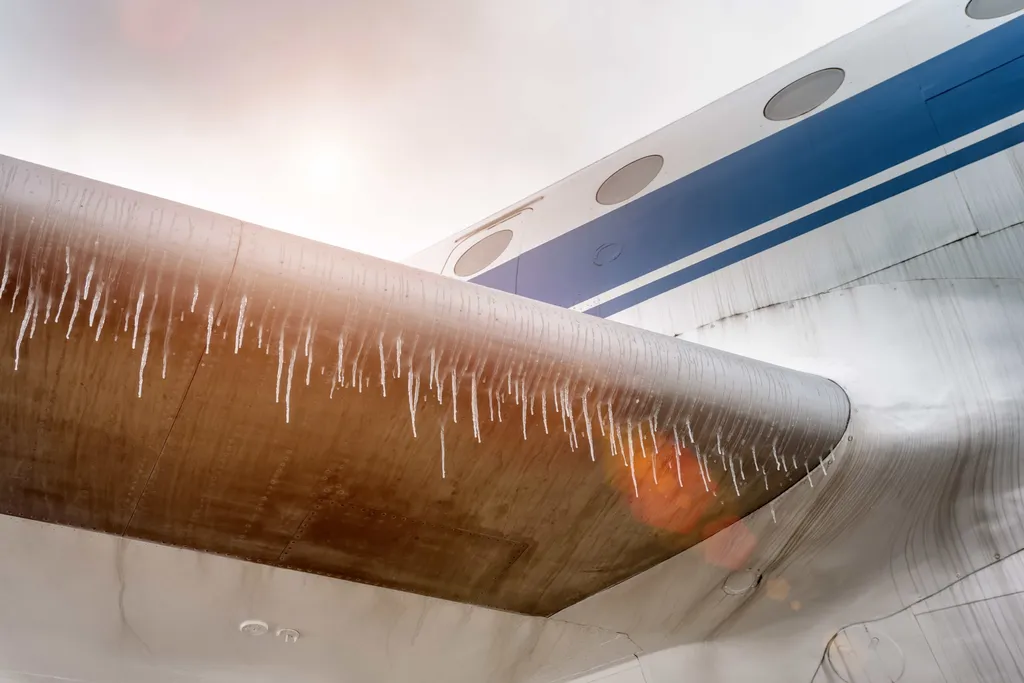
In the world of aviation, the battle against ice is a persistent challenge, one that not only hampers performance but also poses significant safety risks. Researchers from the Faculty of Materials Science and Engineering at Warsaw University of Technology have made a significant stride in this arena, developing a novel approach to enhance the hydrophobic and icephobic properties of polyurethane coatings, a breakthrough that could revolutionize the industry.
The study, led by Anna Łabęda, focuses on modifying polyurethane coatings with organosilicon compounds, specifically Polyhedral Oligomeric Silsesquioxanes (POSS). These compounds, synthesized in the lab, are designed to tailor and boost the hydro- and icephobic properties of the coatings. “The idea was to create a surface that would not only repel water but also delay ice formation and reduce ice adhesion,” explains Łabęda.
The team employed a variety of techniques to evaluate the coatings, including contact angle measurements at room and subzero temperatures, ice adhesion strength analysis, freezing delay time assessment, surface roughness analysis via optical profilometry, and microstructure observation through scanning electron microscopy. The results were promising. The modified coatings exhibited a significant reduction in contact angle hysteresis and roll-off angle compared to a reference sample. Moreover, the ice adhesion was reduced by up to 56%, and the freezing delay time was tripled.
The implications of this research are far-reaching, particularly for the aviation industry. Ice accumulation on aircraft surfaces can lead to loss of aerodynamic properties, economic losses, and safety threats. The development of these advanced coatings could mitigate these issues, enhancing safety and efficiency.
Beyond aviation, the energy sector could also benefit from this technology. Ice formation on wind turbines, power lines, and other infrastructure can lead to operational inefficiencies and safety hazards. The application of these hydrophobic and icephobic coatings could prevent these issues, ensuring smooth and safe operations.
The study, published in *Materials Research Express* (translated to English as “Materials Research Express”), opens up new avenues for research and development in the field of anti-icing surfaces. As Łabęda notes, “This is just the beginning. There’s still much to explore and optimize, but the potential is immense.”
The research not only confirms the effectiveness of targeted molecular modifications in advancing anti-icing surface design but also paves the way for future innovations in this critical area. As the world continues to grapple with the challenges of ice formation, such advancements offer a beacon of hope, promising safer, more efficient, and more reliable operations across various industries.