
In a significant stride towards enhancing energy storage technologies, researchers have unveiled a novel method to boost the performance of MXene-based micro-supercapacitors (MSCs). The study, led by Xuening Jiang from the Key Laboratory of Materials Modification by Laser, Ion and Electron Beams at Dalian University of Technology, China, introduces a simple yet effective technique to modify the microstructure of MXene, a promising electrode material for MSCs. The research was recently published in the Journal of Science: Advanced Materials and Devices, which translates to “Journal of Science: Advanced Materials and Devices” in English.
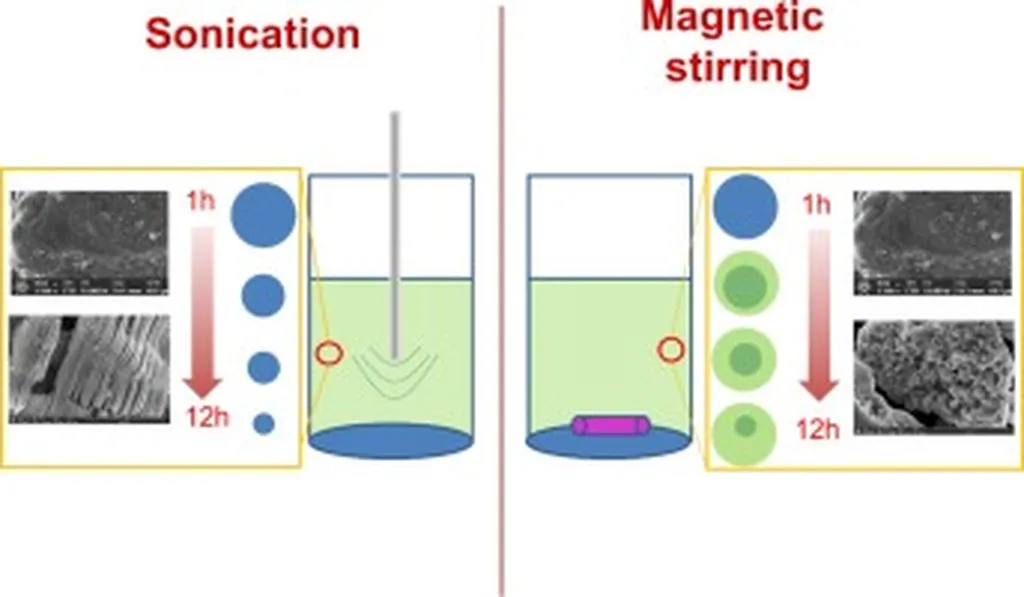
MXene, known for its high electrical conductivity, has long been plagued by its tendency to stack layers, which impedes electrolyte ion accessibility and hampers charge storage performance. Jiang and his team addressed this challenge through a process called ice-bath sonication. By subjecting Ti3C2Tx MXene dispersion to this treatment, they created a microstructure with expanded interlayer spacing, increased porosity, and reduced dimensions. This modification not only preserved the material’s high electrical conductivity but also significantly enhanced its charge storage performance.
The results are impressive. The sonication-induced MXene-MSC demonstrated a 61.3% higher capacitance, 1.5 times improved rate performance, and a 4.2-fold higher energy density compared to its pristine counterpart. “The performance improvement is directly ascribed to the sonication-induced favorable microstructural features in MXene electrodes,” Jiang explained. “These features improve electrolyte accessibility and create optimized ion transport pathways with reduced length and increased efficiency.”
The commercial implications for the energy sector are substantial. Supercapacitors, with their high power density and rapid charge-discharge capabilities, are crucial for applications ranging from renewable energy integration to electric vehicles. The enhanced performance of MXene-based MSCs could accelerate the adoption of these technologies, making them more viable for a broader range of applications.
The study also offers new insights into balancing electrical conductivity and ion transportation for high-performance supercapacitors. “This work provides a new avenue for the rational design of MXene-based electrodes,” Jiang noted. “By optimizing the microstructure, we can achieve a significant improvement in the overall performance of supercapacitors.”
The research not only highlights the potential of MXene in energy storage but also underscores the importance of microstructural modification in enhancing material performance. As the world continues to seek sustainable and efficient energy solutions, such advancements are pivotal in shaping the future of the energy sector. The findings published in the Journal of Science: Advanced Materials and Devices, offer a promising path forward, paving the way for more efficient and high-performance energy storage devices.