
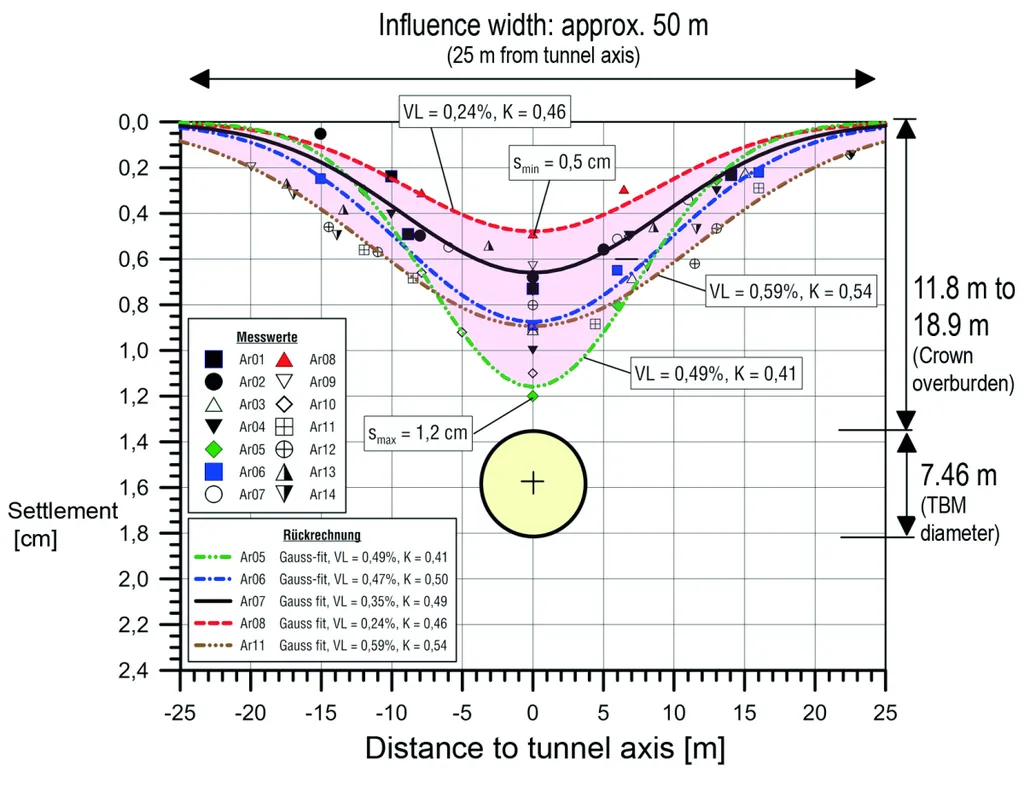
In the bustling heart of Moscow, where the metro system is a lifeline for millions, a groundbreaking study is poised to revolutionize how we predict and manage ground subsidence during tunnel construction. Armen Ter-Martirosyan, a leading researcher from the National Research Moscow State Civil Engineering University, has delved into the intricate world of Tunnel Boring Machine (TBM) technology, offering a novel approach to settlement prediction that could have significant commercial impacts for the energy sector and urban infrastructure development.
Traditionally, settlement prediction during TBM tunneling has relied on volume loss methods, which, while established, are not without their limitations. “This method relies heavily on construction experience and does not directly account for the primary technological parameters affecting soil settlement,” explains Ter-Martirosyan. His research, published in the *International Journal for Computational Civil and Structural Engineering* (Международный журнал по вычислительной гражданской и строительной инженерии), introduces a comprehensive modeling approach that considers all technological factors involved in TBM tunneling.
The study focuses on the Rublyovo–Arkhangelskaya line of the Moscow Metro, dividing the TBM excavation process into sequential phases for finite element analysis. Two calculation schemes were developed: one using the conventional volume loss method and another that incorporates a range of technological parameters, including shield face pressure, grout injection pressure, TBM weight, structural stiffness, and shield tail gap.
The results are compelling. The comprehensive method demonstrated a high degree of quantitative and qualitative agreement with measured values, allowing for a more accurate assessment of soil mechanical behavior over time during TBM excavation. This level of precision is crucial for the energy sector, where underground infrastructure often intersects with existing utilities and critical assets.
“By understanding and predicting ground subsidence more accurately, we can minimize risks and optimize construction processes,” says Ter-Martirosyan. This could translate into significant cost savings and reduced downtime for energy providers, as well as enhanced safety and efficiency for urban infrastructure projects.
The implications of this research extend beyond Moscow. As cities around the world expand their metro systems and underground networks, the need for precise settlement prediction becomes ever more critical. Ter-Martirosyan’s work offers a promising path forward, one that could shape the future of tunneling technology and urban planning.
In an era where technological advancements are reshaping industries, this study stands as a testament to the power of innovation in addressing longstanding challenges. As we look to the future, the insights gleaned from this research could pave the way for safer, more efficient, and more sustainable urban development.