
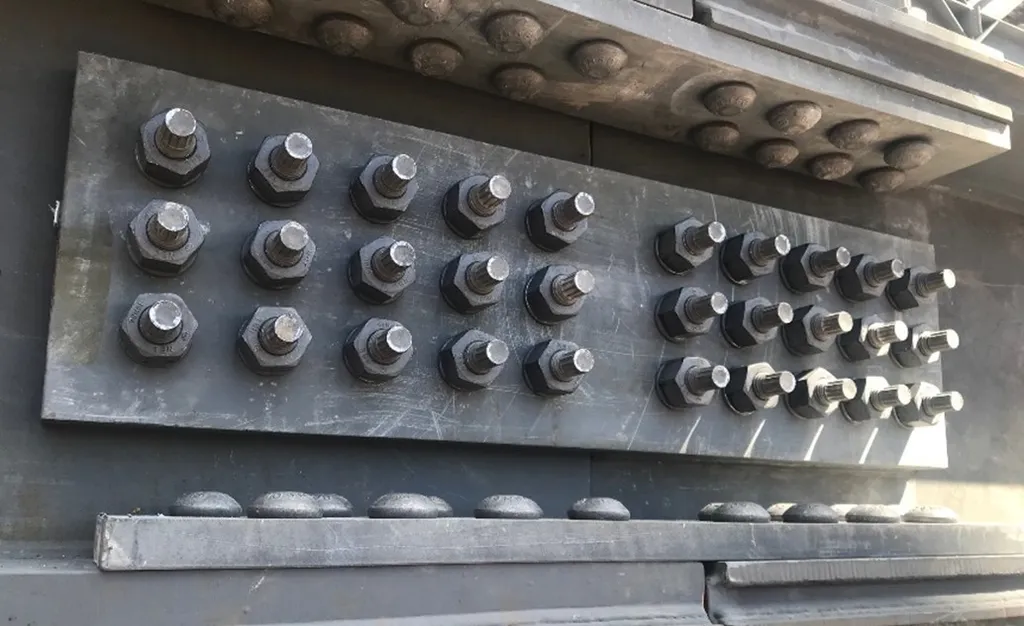
In the world of metal structures, the reliability of bolted connections is paramount, especially in sectors like energy where safety and performance are non-negotiable. A recent study published in the *International Journal for Computational Civil and Structural Engineering* (translated from Russian as *Международный журнал по вычислительной гражданской и строительной инженерии*) sheds light on the stress-strain state of slip-critical connections, offering insights that could revolutionize how we approach bolt tension control.
At the heart of this research is Andrey Vasilkin, a lead author from the National Research Moscow State University of Civil Engineering. Vasilkin and his team delved into the critical factors affecting the load-bearing capacity of slip-critical connections: the bolt tension force and the friction coefficient between coupled surfaces. “Reliably achieving the specified tension force is necessary to guarantee the design performance of the connection,” Vasilkin emphasizes. This statement underscores the importance of precise bolt tensioning in ensuring the structural integrity of metal constructions.
The study meticulously analyzes the requirements and guidelines of both foreign and domestic regulatory documents, drawing from extensive research in the construction industry and adjacent fields. Vasilkin’s team identified the most reasonable methods for further study of bolt tension control, highlighting the torque method as the most well-regulated and practical approach currently in use.
One of the standout contributions of this research is the proposal of an analytical model that describes the stress-strain state of a slip-critical connection. This model establishes a crucial relationship between the bolt tension force and the nut rotation angle. The findings were compared with recommendations from foreign regulations, providing a robust framework for understanding and improving bolt tension control.
To validate their theoretical model, the researchers conducted experimental studies on high-strength bolt sets of various diameters—M16, M20, and M24. They described and analyzed the relationships between the nut rotation angle, torque, and tension in the bolt body. The data obtained were compared with the proposed calculation model, revealing the nut rotation angles that allow the design bolt tension force to be achieved. This practical application of the research could significantly enhance the precision and reliability of bolt tensioning in real-world scenarios.
The implications of this research are far-reaching, particularly for the energy sector. In industries where metal structures are subjected to high stresses and dynamic loads, ensuring the integrity of bolted connections is crucial. The insights gained from this study could lead to more efficient and safer construction practices, ultimately reducing maintenance costs and enhancing the longevity of structures.
As Vasilkin and his team continue to refine their methods, the future of bolt tension control looks promising. Their work not only advances our understanding of slip-critical connections but also paves the way for innovative solutions that could transform the construction industry. For professionals in the energy sector, this research offers a glimpse into a future where structural reliability is not just a goal but a guaranteed outcome.
In the ever-evolving landscape of construction technology, this study stands as a testament to the power of rigorous research and its potential to drive meaningful change. As we look ahead, the insights from Vasilkin’s work will undoubtedly shape the way we approach bolt tension control, ensuring that our structures are not just built to last but built to excel.