
In the ever-evolving world of construction materials and techniques, a groundbreaking study has emerged that could significantly impact the energy sector and beyond. Researchers, led by Margarita Amelina from the National Research Moscow State University of Civil Engineering, have delved into the behavior of reinforced high-strength lightweight concrete under complex stress states, specifically combined eccentric compression and torsion. Their findings, published in the *International Journal for Computational and Civil Engineering* (Международный журнал вычислительной гражданской и строительной инженерии), offer promising insights for the future of construction and structural engineering.
The study focuses on the deformation and failure patterns of these innovative concrete elements, which are increasingly being considered for their potential to reduce the weight and energy consumption of buildings. “We wanted to understand how these materials behave under real-world conditions,” Amelina explains. “The results could pave the way for more efficient and safer structures, particularly in the energy sector where lightweight and high-strength materials are in high demand.”
One of the key findings is the unique crack formation pattern in high-strength lightweight reinforced concrete. Under combined loading, spatial cracks develop, with one dominant crack eventually leading to failure. This behavior is distinct from that of conventional normal-weight concrete. “The deformation stage after crack initiation is more than two times shorter,” Amelina notes. “This is crucial information for engineers designing structures that need to withstand complex stress states.”
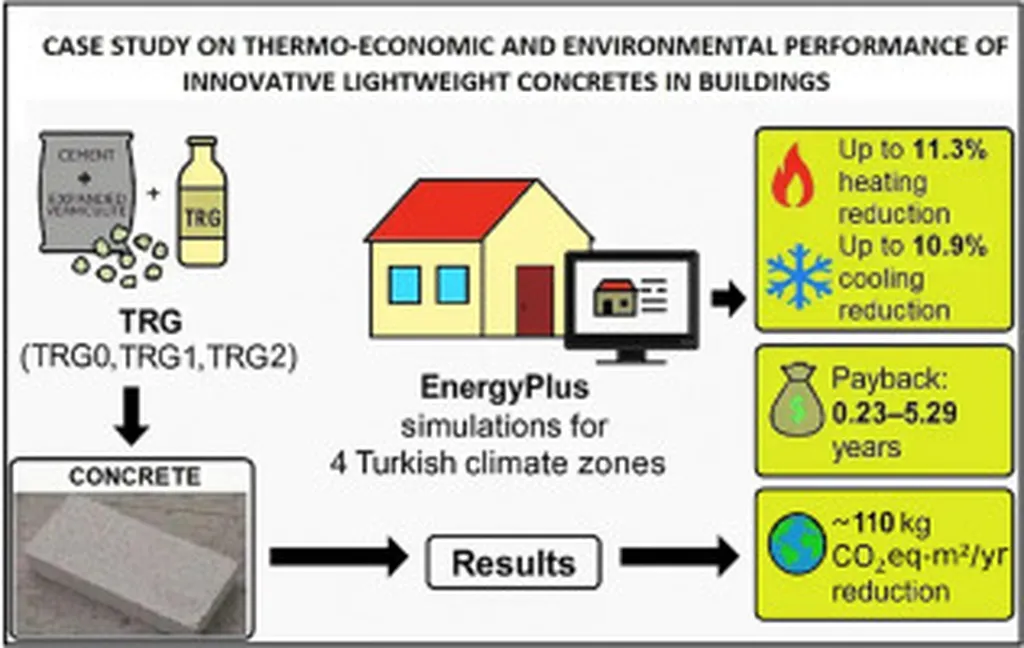
The implications for the energy sector are substantial. Lightweight concrete can reduce the overall weight of structures, leading to lower energy consumption in construction and operation. This is particularly relevant for tall buildings and large-scale infrastructure projects, where the use of high-strength, lightweight materials can significantly cut down on material costs and energy use.
Moreover, the study’s analytical model, which accurately predicts the experimental data, offers a practical tool for engineers. “Our model can be used to design structures with greater confidence,” Amelina states. “This could lead to more widespread adoption of high-strength lightweight concrete in various applications, including energy-efficient buildings and infrastructure.”
The research not only advances our understanding of material behavior but also opens up new possibilities for innovation in the construction industry. As the demand for sustainable and energy-efficient structures grows, the insights from this study could play a pivotal role in shaping the future of construction and structural engineering.
In the words of Margarita Amelina, “This is just the beginning. The potential for high-strength lightweight concrete is vast, and we are excited to see how our findings will influence the next generation of construction projects.”