
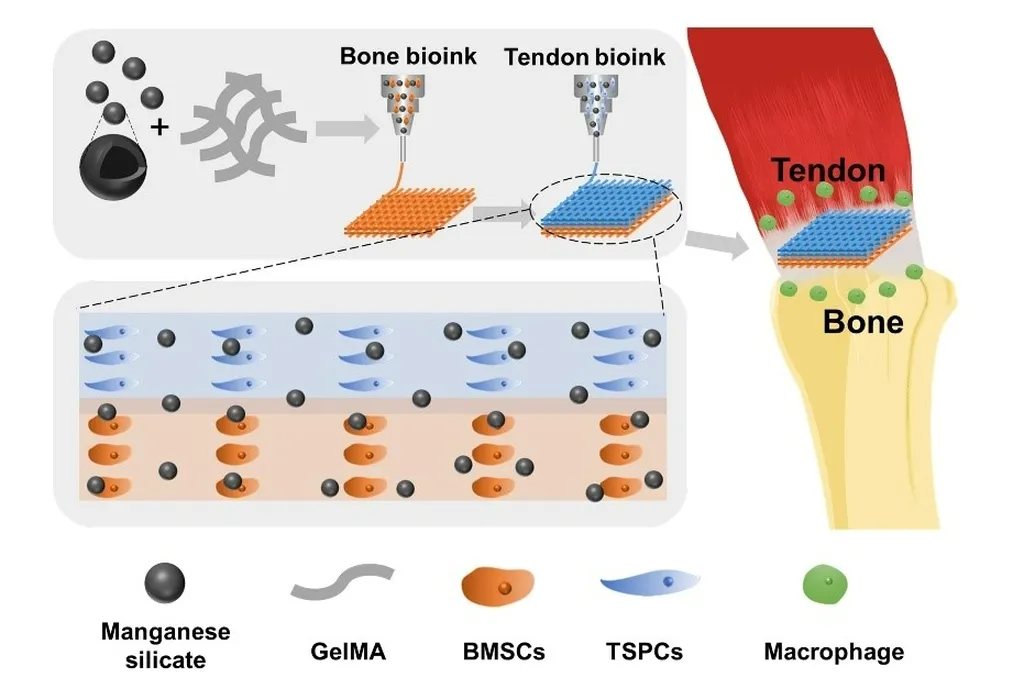
In the realm of regenerative medicine, a groundbreaking review published in *Bioactive Materials* (which translates to *Bioactive Materials* in English) is shedding light on innovative strategies for healing tendon-bone interface (TBI) injuries. Led by Xinghao Yin from the Department of Orthopaedic Surgery at Shanghai Sixth People’s Hospital and the Shanghai Engineering Research Center for Orthopaedic Material Innovation and Tissue Regeneration, this research delves into the complexities of TBI healing and the promising role of hydrogels in this process.
TBI injuries are a significant concern, particularly in an aging population and amidst a global push for physical activity. These injuries can severely impair physical function and overall well-being, making effective treatments a priority. The challenge lies in the anatomical gradient structure of the TBI and the spatiotemporal complexity of its cellular composition and distribution.
“Understanding the vulnerability of the TBI under physiological conditions and the spatial gradient distribution of various functional cell types is crucial,” Yin explains. “This knowledge is foundational for developing effective regenerative strategies.”
The review highlights recent advances in tissue engineering that have endowed hydrogels with unique biological properties, making them promising candidates for TBI repair. Hydrogels can mimic the gradient architecture of native TBI tissue, potentially improving clinical outcomes.
The research categorizes current hydrogel-based strategies for enhancing TBI healing into four main types: improving hydrogel physicochemical properties, mimicking native anatomical structures, replicating dynamic gradients of cells and cytokines, and responding adaptively to the healing microenvironment.
“This review provides insights into the design of highly bio-adapted hydrogels tailored to the gradient structure and biological property of the TBI,” Yin notes. “It offers guidance for future research on hydrogel-based therapeutic strategies.”
The implications of this research extend beyond the medical field. In the energy sector, for instance, understanding and improving regenerative processes can lead to advancements in biomimetic materials and technologies. The development of bio-adapted hydrogels could inspire innovations in materials science, leading to more durable and efficient energy solutions.
As the field of regenerative medicine continues to evolve, this research serves as a beacon, illuminating the path forward. By leveraging the unique properties of hydrogels, scientists and engineers can work together to develop innovative solutions that improve quality of life and drive technological advancements across various industries.