
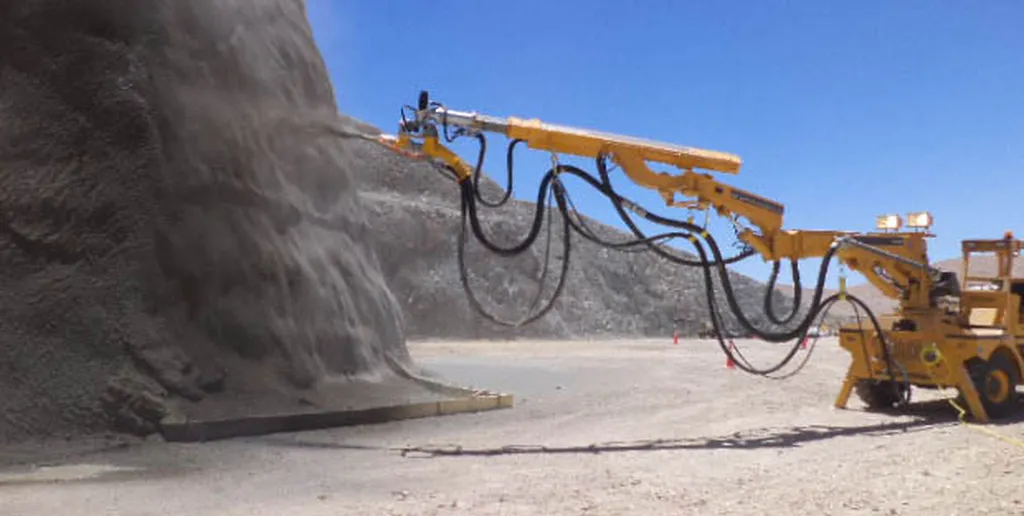
In the world of construction, particularly in tunneling and underground infrastructure, shotcrete has long been a go-to material for its speed and versatility. However, the high rebound rate of shotcrete has been a persistent challenge, leading to material waste and suboptimal support during initial construction phases. A recent study published in the journal *Advances in Civil Engineering* (translated from Chinese as *Advances in Civil Engineering Materials*) sheds new light on this issue, offering promising solutions that could significantly impact the energy sector and beyond.
Led by Jinli Wang from the CCCC Construction Group Co. Ltd., the research delves into the rebound performance of shotcrete, exploring how various additives can enhance its effectiveness. The study incorporates silica fume, microspheres, and early-strength shrinkage-reducing agents to tackle the rebound problem head-on. “The current rebound rate of shotcrete is high and does not meet the support requirements in the initial stages of construction,” Wang explains. “Our goal was to find ways to reduce this rebound rate and improve the overall performance of shotcrete.”
The research employs a sophisticated computational fluid dynamics–discrete element method (CFD-DEM) coupled numerical simulation to investigate the hydration process of these materials. This advanced approach allows for a detailed understanding of how different particles behave during the spraying process. Field test findings were used to validate the simulations, providing a robust framework for analyzing the rebound phenomenon.
One of the key findings is that the inclusion of silica fume, microspheres, and early-strength shrinkage-reducing agents significantly reduces the rebound rate of sprayed concrete. This is a game-changer for the construction industry, particularly in the energy sector where underground infrastructure is crucial. “Larger particles have slower velocities but more stable motion, while smaller particles have higher velocities but stronger dispersion,” Wang notes. “Higher normal and tangential stiffness per unit area of particles results in increased concrete viscosity and cohesion, leading to a lower rebound rate.”
The study also identifies a circular area with a radius nine times that of the nozzle outlet as the effective spraying range of concrete. This insight could lead to more precise and efficient application techniques, reducing waste and improving the quality of the final structure. Additionally, the research highlights that greater heat release during early concrete hydration corresponds to a quicker hydration reaction rate. This enables cementitious materials to encapsulate particles sooner, increasing overall cohesion, strength, and reducing rebound rates.
The numerical simulation results show errors within 5%–10% compared to experimental data, demonstrating the accuracy and reliability of the CFD-DEM coupling method in predicting shotcrete rebound behavior. This level of precision is crucial for the energy sector, where the integrity of underground structures is paramount.
The implications of this research are far-reaching. By reducing the rebound rate of shotcrete, construction projects can achieve better support in the initial stages, leading to more stable and durable structures. This is particularly relevant for the energy sector, where the construction of tunnels, shafts, and other underground infrastructure is essential for the development of renewable energy sources and the expansion of existing energy networks.
As the construction industry continues to evolve, the findings from this study could shape future developments in the field. The use of advanced simulation techniques and the incorporation of innovative additives offer a glimpse into the future of construction materials. “Our research demonstrates the potential of these materials and methods to revolutionize the way we approach shotcrete application,” Wang concludes.
In the quest for more efficient and sustainable construction practices, this study provides valuable insights that could pave the way for significant advancements. As the energy sector continues to grow and demand for underground infrastructure increases, the findings from this research will be instrumental in shaping the future of construction.