
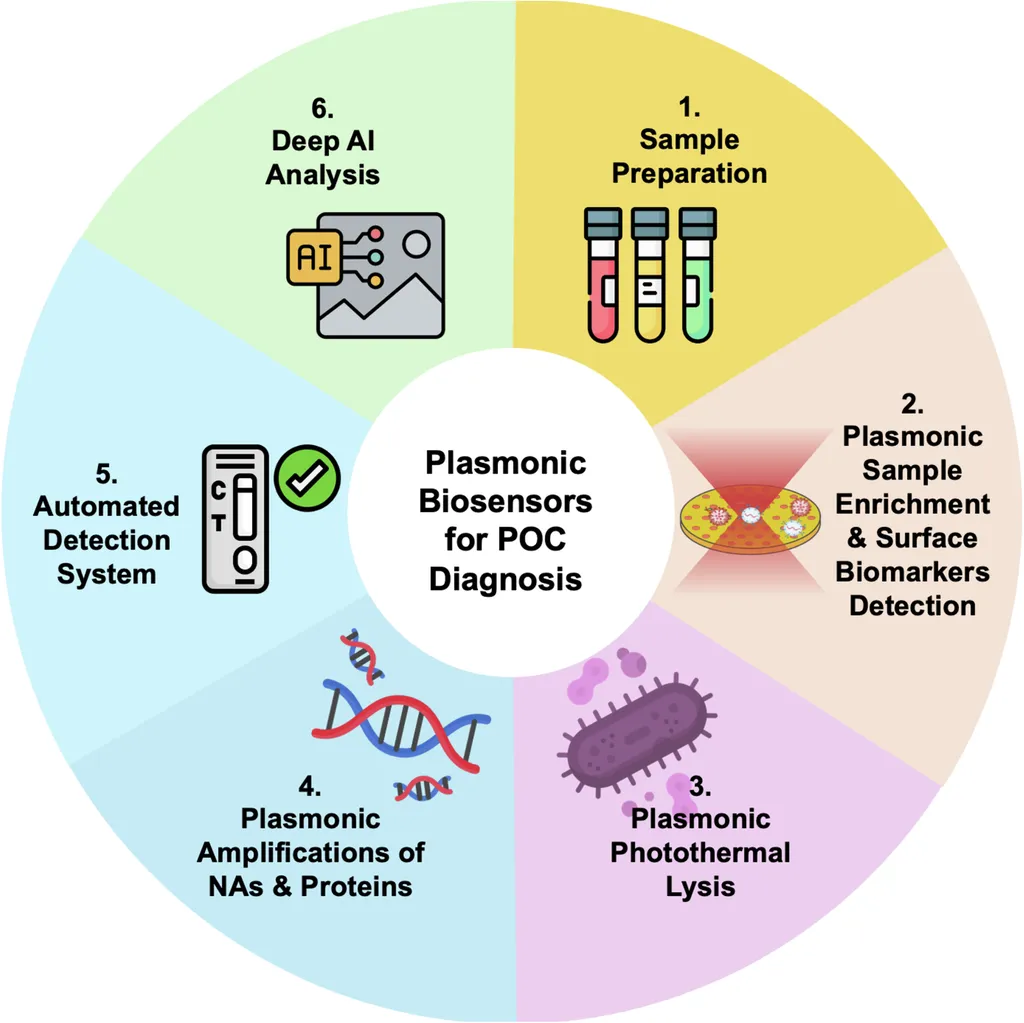
In the bustling world of biosensor technology, a groundbreaking development has emerged that promises to revolutionize the way we detect and analyze biomolecules. Researchers, led by M. Sahaya Sheela from the Department of Electronics and Communication Engineering at Vel Tech Rangarajan Dr. Sagunthala R&D Institute of Science and Technology, have introduced an innovative framework that combines the power of machine learning with plasmonic biosensors. This cutting-edge approach, detailed in a recent study published in *Discover Nano* (which translates to “Exploring the Nanoscale”), is set to accelerate the development of ultra-sensitive biosensors, with significant implications for the energy sector and beyond.
Plasmonic biosensors, such as Surface Plasmon Resonance (SPR) and Surface-Enhanced Raman Spectroscopy (SERS), have long been celebrated for their ability to provide real-time, label-free detection of biochemical interactions. However, optimizing these sensors for maximum sensitivity and selectivity has been a persistent challenge due to the complex nature of plasmonic interactions with various biomolecules. Enter SERA, an AI-driven framework that integrates machine learning algorithms with experimental SERS data to predict and optimize plasmonic sensing performance.
“Our goal was to streamline the optimization process and eliminate the need for extensive trial-and-error experimentation,” explains Sheela. “By leveraging machine learning, we can rapidly predict key parameters such as resonance shift, intensity variations, and molecular binding efficiency, allowing for more efficient and effective biosensor design.”
The SERA framework utilizes supervised learning techniques, training on a spectral dataset known as SERS-DB, which encompasses data from various plasmonic nanostructures. The model’s predictive capabilities were put to the test on a dataset of 420 samples for training and 180 for testing, covering six different classes of biomolecules. The results were impressive, with an accuracy of 92%, precision and recall of 90%, and an F1-score of 92%. The model demonstrated exceptional performance across all six classes, achieving an overall score of around 0.90.
Comparative analysis with conventional methods further underscored the superiority of the SERA framework, showcasing a 92% accuracy, 1000 nm/RIU sensitivity, and 95% optimization efficiency. These findings highlight a scalable and cost-effective strategy for advancing biosensor technology, with profound implications for medical diagnostics, environmental monitoring, and bio photonics.
The commercial impacts of this research are particularly noteworthy for the energy sector. Enhanced biosensors can play a crucial role in monitoring and optimizing energy production processes, detecting contaminants, and ensuring the safety and efficiency of energy systems. By enabling real-time adaptive sensing based on live data, the SERA framework can contribute to more sustainable and efficient energy solutions.
As the world continues to grapple with complex environmental and health challenges, the integration of machine learning with plasmonic biosensors offers a promising path forward. The research led by Sheela and her team not only advances our understanding of biosensor technology but also paves the way for innovative applications that can drive progress in various industries, including energy.
In the words of Sheela, “This research represents a significant step forward in the field of biosensors. By harnessing the power of machine learning, we can unlock new possibilities for detection, analysis, and optimization, ultimately contributing to a healthier and more sustainable future.”
As this technology continues to evolve, it will be fascinating to see how it shapes the future of biosensor development and its impact on the energy sector and beyond. The study, published in *Discover Nano*, serves as a testament to the transformative potential of interdisciplinary research and the power of innovation in addressing global challenges.