
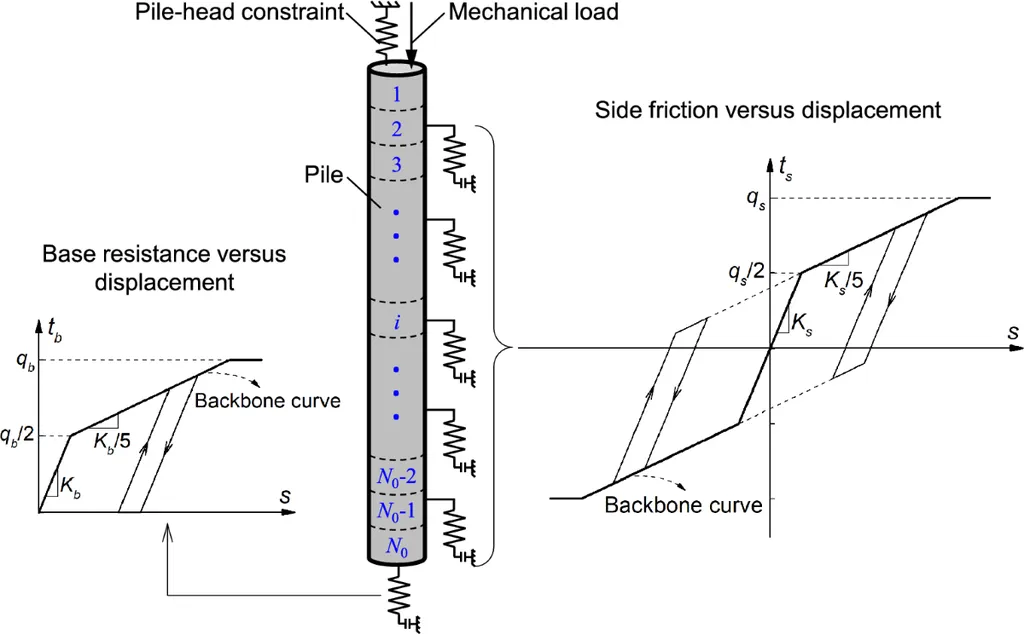
In the world of construction, particularly in the energy sector where foundations for critical infrastructure are paramount, understanding the behavior of piles under load is crucial. A recent study published in the *Scientific and Technical Bulletin of Bryansk State University* (Научно-технический вестник Брянского государственного университета) sheds new light on this very topic. Led by K.P. Mandrovskiy from the Moscow Automobile and Road Construction State Technical University, the research aims to verify the applicability of standard calculation methods for pile settlement to small-scale pile models.
The study delves into various methods for determining pile settlement, ranging from semi-empirical dependencies to engineering calculations based on soil mechanics principles, and even numerical methods grounded in mechanics. Mandrovskiy and his team conducted experiments using small-scale models of abrasive piles, fashioned as metal rods, in deep, finely dispersed loam that was frozen. The team employed a mix of gravel, sand, cement, and salt for concrete pouring, and monitored temperature variations at different soil depths using a weather station with an external sensor and a specialized temperature measuring well.
After applying a three-stage static load to the pile models, the researchers observed the relationship between the vertical settlement of the piles and the static pressure load. They then compared these experimental results with theoretical calculations based on the Russian standard SP 24.13330.2011. The findings could have significant implications for the energy sector, where accurate prediction of pile settlement is essential for the stability and safety of structures such as wind turbines, oil rigs, and other critical infrastructure.
“Our study highlights the importance of validating standard methods with experimental data, especially when scaling down models,” Mandrovskiy explained. “This ensures that the calculations used in real-world applications are as accurate as possible, ultimately leading to safer and more cost-effective construction practices.”
The research not only contributes to the academic understanding of pile settlement but also offers practical insights for engineers and construction professionals. By bridging the gap between theoretical calculations and real-world applications, this study could shape future developments in the field, particularly in the energy sector where precision and reliability are non-negotiable.
As the energy sector continues to evolve, with a growing emphasis on renewable energy sources and offshore installations, the need for robust and reliable foundation solutions becomes ever more pressing. This research provides a stepping stone towards achieving those goals, ensuring that the foundations of our future infrastructure are built on solid ground.