
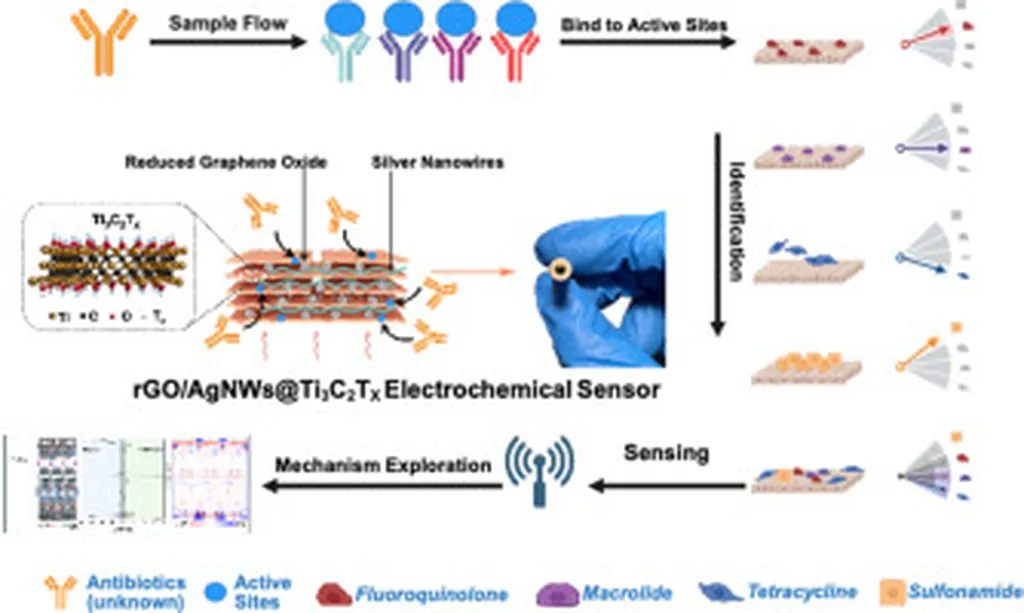
In the quest to monitor and mitigate environmental pollution, researchers have made a significant stride with the development of a highly sensitive electrochemical sensor. This innovation, spearheaded by Jianlei Chen from the State Key Laboratory of Mariculture Biobreeding and Sustainable Goods at the Yellow Sea Fisheries Research Institute, Chinese Academy of Fishery Sciences, focuses on detecting nitrofurazone (NFZ) in seawater. The sensor, detailed in a recent study published in the Journal of Science: Advanced Materials and Devices (《先进材料与器件科学》), leverages a nanocomposite of MXene and graphene (Gr) to enhance electron transfer rates and active surface area, offering a promising tool for environmental and food safety applications.
Nitrofurazone, a broad-spectrum antibiotic, is often used in aquaculture to prevent and treat bacterial infections. However, its residues can pose significant risks to marine ecosystems and human health. Traditional detection methods are often time-consuming and require sophisticated laboratory equipment. The newly developed sensor addresses these challenges by providing a rapid, sensitive, and cost-effective solution for on-site monitoring.
The sensor’s performance was optimized by fine-tuning key parameters such as modifier volume, activation cycles, and solution pH. Under optimal conditions, it demonstrated a wide linear detection range from 1 to 70 μmol/L, with excellent repeatability, stability, and selectivity against common antibiotic interferents. When tested on spiked seawater samples, the sensor achieved impressive recovery rates ranging from 96.01% to 102.16%, with a relative standard deviation below 1.3%.
“This sensor not only provides a reliable tool for on-site monitoring of antibiotic residues in marine environments but also showcases the potential of MXene-based composites in advanced electrochemical biosensing platforms,” said Jianlei Chen, the lead author of the study. The implications of this research extend beyond environmental monitoring. The sensor’s ability to detect low concentrations of antibiotics with high accuracy and reliability could revolutionize food safety inspections, ensuring that seafood products are free from harmful residues.
The commercial impact of this technology is substantial. For the energy sector, which increasingly intersects with environmental monitoring and sustainability efforts, such sensors could be integrated into larger monitoring systems to ensure compliance with environmental regulations. This could lead to more efficient and effective management of marine resources, ultimately benefiting both the environment and the industries that rely on it.
The development of this MXene-Gr-based sensor represents a significant advancement in the field of electrochemical sensing. As Jianlei Chen noted, “The synergistic effect of MXene and graphene significantly enhances the sensor’s performance, paving the way for future innovations in environmental and food safety applications.” This research not only highlights the potential of MXene-based composites but also underscores the importance of interdisciplinary collaboration in addressing global challenges.
In the broader context, this study serves as a testament to the power of advanced materials and nanotechnology in solving real-world problems. As the world grapples with the consequences of pollution and environmental degradation, such innovations offer hope for a cleaner, safer future. The journey towards sustainable development is fraught with challenges, but with each breakthrough, we move one step closer to achieving our goals.