
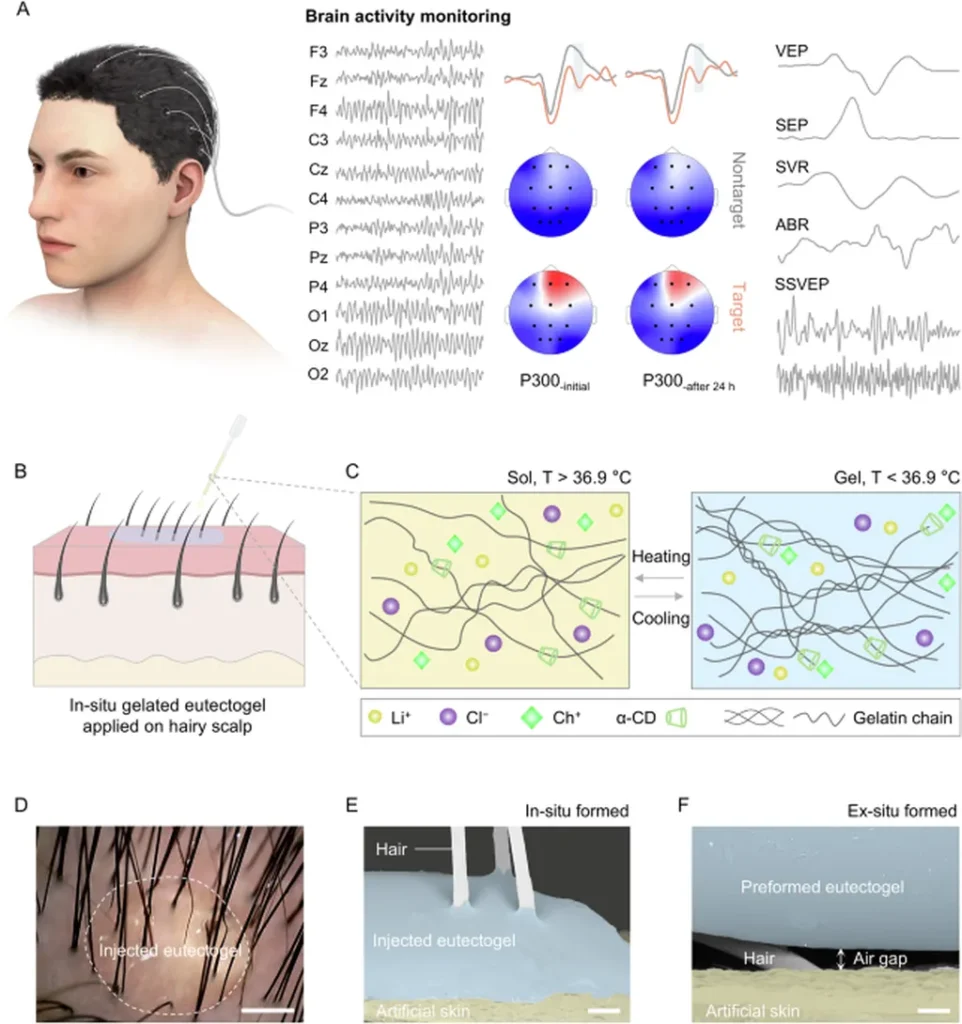
In a groundbreaking development poised to revolutionize neuroscience research and clinical diagnostics, a team of researchers has introduced an innovative injectable eutectogel that promises to enhance the quality and longevity of scalp electroencephalogram (EEG) monitoring. This advancement, led by Yuli Wang from the Department of Chemical Engineering at the Guangdong Technion-Israel Institute of Technology, addresses long-standing challenges associated with traditional hydrogel-based electrodes.
The new eutectogel-enabled electrode offers a robust solution for high-quality, long-term EEG monitoring. Unlike conventional hydrogels, which often suffer from poor scalp compliance, high impedance, and instability, this gelatin-based eutectogel exhibits remarkable properties. It undergoes temperature-controlled reversible phase transitions, allowing for rapid in-situ gelation on the scalp and forming a strong self-adhesive interface. “This gelation process is crucial as it ensures a secure and stable connection between the electrode and the scalp, which is essential for accurate EEG readings,” explains Wang.
The eutectogel demonstrates exceptional mechanical durability, enduring up to 1000 cycles at 100% strain, and robust adhesion, with a remarkable 0.7 N/cm² on human epidermis and 1.7 N/cm² on Ag/AgCl electrodes. Additionally, it boasts outstanding anti-drying properties, showing negligible water loss after seven days. These properties make it ideal for long-term monitoring, a significant advancement over existing technologies.
One of the most compelling aspects of this research is its potential to transform the energy sector, particularly in the realm of wearable and implantable medical devices. The eutectogel’s superior healing properties, antibacterial characteristics, and recyclability open new avenues for developing sustainable and efficient medical technologies. “The ability to recycle the eutectogel not only reduces waste but also lowers the overall cost of EEG monitoring, making it more accessible for both clinical and research applications,” Wang adds.
The practical applications of this technology are vast. It can be used to monitor visual evoked potentials, steady-state visual evoked potentials, somatosensory evoked potentials, slow vertex response, auditory brainstem response, and multi-channel cognitive EEG during various daily activities. The eutectogel’s low scalp-electrode contact impedance (<20 kΩ at 16 Hz) ensures high-fidelity recordings, making it a versatile tool for diverse clinical and research settings. Published in the journal npj Flexible Electronics (translated to English as "npj Flexible Electronics"), this research represents a significant leap forward in the field of neuroscience and medical technology. As the demand for advanced EEG monitoring grows, the eutectogel-enabled electrode offers a promising solution that combines durability, efficiency, and sustainability. The implications of this research extend beyond immediate applications. It sets the stage for future developments in wearable medical devices, implantable technologies, and even energy-efficient sensors. By addressing the limitations of traditional hydrogels, this innovation paves the way for more reliable and long-term monitoring solutions, ultimately enhancing the quality of neuroscience research and clinical diagnostics. In a field where precision and longevity are paramount, the injectable eutectogel stands out as a game-changer. Its unique properties and wide-ranging applications make it a valuable asset for researchers and clinicians alike, driving forward the boundaries of what is possible in EEG monitoring and beyond.