
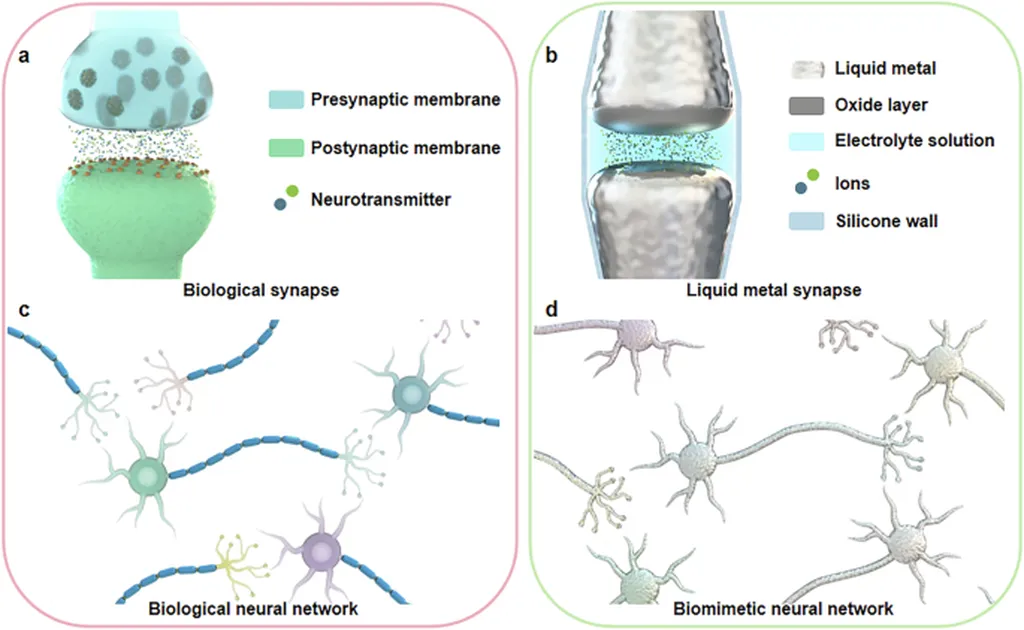
In a groundbreaking development that could revolutionize the energy sector, researchers have unveiled a novel biomimetic liquid metal synapse (LMS) that mimics the adaptive, self-repairing capabilities of biological neural networks. This innovation, led by Chunxue Wan of the State Key Laboratory of Cryogenic Science and Technology at the Technical Institute of Physics and Chemistry, Chinese Academy of Sciences, opens new avenues for flexible intelligent devices and energy-efficient technologies.
The LMS operates on a principle distinct from conventional electronic state transitions, drawing inspiration from the electrochemical structural plasticity observed in biological systems. At the heart of this technology lies the liquid metal-electrolyte junction, where synergistic changes in the interfacial oxide layer and ion concentration enable precise modulation of synaptic strength. This dynamic interaction allows the LMS to replicate fundamental neurobiological functions, such as signal transmission and long-term plasticity, through permanent morphological and compositional reconstruction.
“Our research demonstrates that the inherent deformability, self-repair capacity, and high conductivity of liquid metal can facilitate the design of neural networks that replicate the dynamic, adaptive signaling essential for flexible intelligent devices,” explains Wan. This adaptability is particularly promising for the energy sector, where the demand for efficient, resilient, and flexible technologies is ever-growing.
The potential commercial impacts of this research are vast. For instance, the LMS could be integrated into smart grids, enabling real-time monitoring and adaptive control of energy distribution. This could significantly enhance energy efficiency and reduce waste, addressing critical challenges in the energy sector. Moreover, the self-repairing capabilities of the LMS could lead to more durable and reliable energy storage solutions, such as advanced batteries and supercapacitors.
The insights from the LMS suggest a promising pathway for future research into next-generation neural functional architectures. As the world moves towards a more sustainable and energy-efficient future, innovations like the LMS could play a pivotal role in shaping the technologies that will power our societies.
Published in the journal npj Flexible Electronics (which translates to “Nano Research: Flexible Electronics” in English), this research marks a significant step forward in the field of flexible electronics and neural networks. The study not only advances our understanding of biomimetic technologies but also paves the way for practical applications that could transform the energy sector and beyond.
As we stand on the brink of a new era in intelligent devices and energy technologies, the work of Chunxue Wan and her team serves as a beacon of innovation, inspiring further exploration and development in this exciting field. The journey towards a smarter, more efficient future has just begun, and the LMS is leading the way.