
In the heart of Hangzhou, China, a team of researchers led by Tuya Naren from Zhejiang University is revolutionizing the way we understand and interact with one of the body’s most vital organs: the kidney. Their work, published in the journal *Bioactive Materials* (translated as *活性材料*), is paving the way for advancements that could have significant implications for the energy sector, particularly in drug development and safety testing.
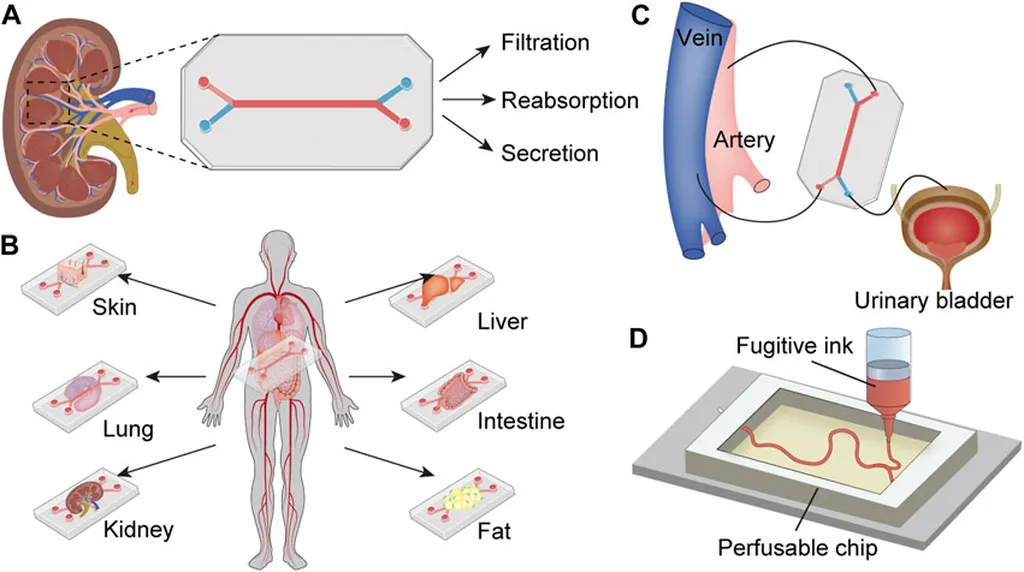
Naren and her team are at the forefront of a cutting-edge technology known as “organ-on-a-chip.” Specifically, they are developing a “renal barrier-on-a-chip” system, a miniature, bioengineered platform that mimics the complex structure and function of the human kidney. This technology promises to overcome the limitations of traditional animal models and two-dimensional cell cultures, offering a more accurate and efficient way to study kidney function and disease.
The kidney-on-a-chip system is designed to replicate three critical components of the renal barrier: the glomerular filtration barrier (GFB), the tubular reabsorption barrier (TRB), and the collecting duct regulatory barrier (CDRB). By integrating biomimetic materials and dynamic microenvironments, the system can closely mimic the structural and functional characteristics of these barriers.
“Our goal is to create a platform that can accurately model the human kidney,” Naren explains. “This technology has the potential to transform drug development by providing a more reliable way to predict nephrotoxicity—the kidney’s response to drugs—and to investigate the mechanisms of kidney diseases.”
The implications for the energy sector are substantial. Many industries, including energy, rely on extensive drug development and safety testing. Traditional methods often involve animal testing, which is not only ethically controversial but also time-consuming and expensive. The kidney-on-a-chip system offers a more efficient and cost-effective alternative, potentially accelerating the drug development process and reducing the need for animal testing.
The technology’s potential extends beyond drug development. It can also be used to study the effects of environmental toxins on kidney function, a critical area of research for industries that deal with hazardous materials. By providing a more accurate model of the human kidney, the kidney-on-a-chip system can help identify potential health risks and develop safer practices.
Despite its promise, the technology is not without its challenges. Naren acknowledges that there are still hurdles to overcome, particularly in terms of material properties and long-term functional maintenance. However, she is optimistic about the future. “Ongoing advancements in organ-on-a-chip design and integration are poised to enhance its application in precision medicine and kidney disease research,” she says.
As the energy sector continues to evolve, the need for innovative solutions to drug development and safety testing will only grow. The work of Naren and her team at Zhejiang University represents a significant step forward in this area, offering a glimpse into a future where technology and medicine converge to improve human health and safety.
In the words of Naren, “This technology has the potential to transform the way we approach kidney disease research and drug development. It’s an exciting time for the field, and we’re just getting started.”