
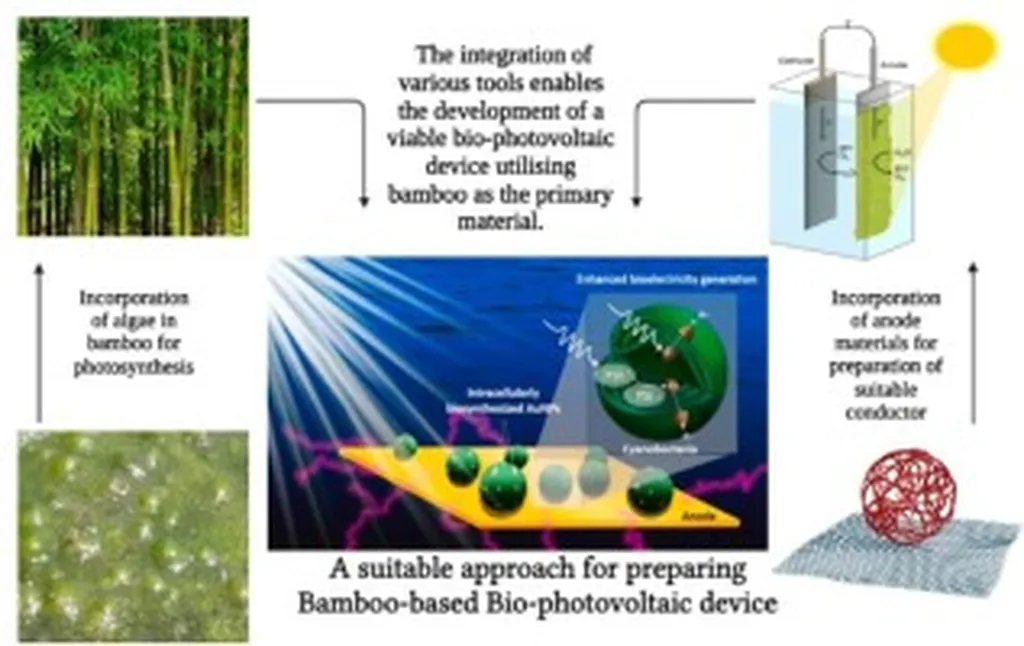
In a groundbreaking development that could reshape the landscape of solar energy, researchers have unveiled a novel method for producing nickel oxide (NiO) nanostructures using bamboo shoot extract. This innovative approach, detailed in a recent study published in ‘Materials Research Express’ (translated as ‘Expressions of Materials Research’), not only offers a sustainable alternative to traditional chemical synthesis methods but also paves the way for more efficient and eco-friendly solar cells.
The study, led by Stella Nasejje from the Department of Physics at Kyambogo University in Uganda, focuses on the creation of two-dimensional (2D) NiO nanostructures. These nanostructures are highly sought after in the energy sector due to their exceptional surface area-to-volume ratio, which enhances their performance in solar cells. “The surface morphology, area, and pores of NiO significantly impact its performance,” Nasejje explains. “Our method addresses these factors while also being environmentally friendly.”
Traditional methods for synthesizing NiO nanostructures often involve hazardous precursors and complex processes. Nasejje and her team have circumvented these issues by employing a bioengineering technique using bamboo shoot extract. This method not only simplifies the production process but also reduces the environmental footprint. “We wanted to find a way to produce NiO nanostructures that is both cost-effective and sustainable,” Nasejje says. “Using bamboo shoot extract allows us to achieve this goal.”
The bioengineered NiO nanostructures exhibit high crystallinity and a unique honeycomb-like morphology. These properties make them ideal for use in dye-sensitized solar cells (DSSCs), a type of solar cell known for its high efficiency and low cost. The researchers integrated the nanostructures into a DSSC, demonstrating their viability as a counter electrode. The cell achieved a short-circuit current density of 0.113 mA cm^−2 and an efficiency of 0.0057%, which, while modest, represents a promising starting point for further optimization.
The study also employed Density Functional Theory (DFT) calculations to support the experimental results. These calculations revealed that NiO is a p-type semiconductor with a direct band gap for spin-down at Γ, providing valuable insights into its electronic properties.
The implications of this research are far-reaching for the energy sector. As the world continues to shift towards renewable energy sources, the development of efficient and sustainable solar cells is crucial. The bioengineered NiO nanostructures offer a viable solution that could accelerate this transition. “This method has the potential to revolutionize the way we produce solar cells,” Nasejje notes. “It’s a step towards a more sustainable and energy-efficient future.”
The study’s findings not only highlight the potential of bioengineered NiO nanostructures but also underscore the importance of interdisciplinary research. By combining experimental and theoretical approaches, the researchers have provided a comprehensive understanding of the material’s properties and potential applications. This holistic approach is likely to inspire further innovation in the field of solar energy.
As the energy sector continues to evolve, the development of sustainable and efficient technologies will be paramount. The bioengineered NiO nanostructures represent a significant advancement in this regard, offering a glimpse into the future of solar energy. With further research and optimization, these nanostructures could play a pivotal role in shaping the energy landscape of tomorrow.