
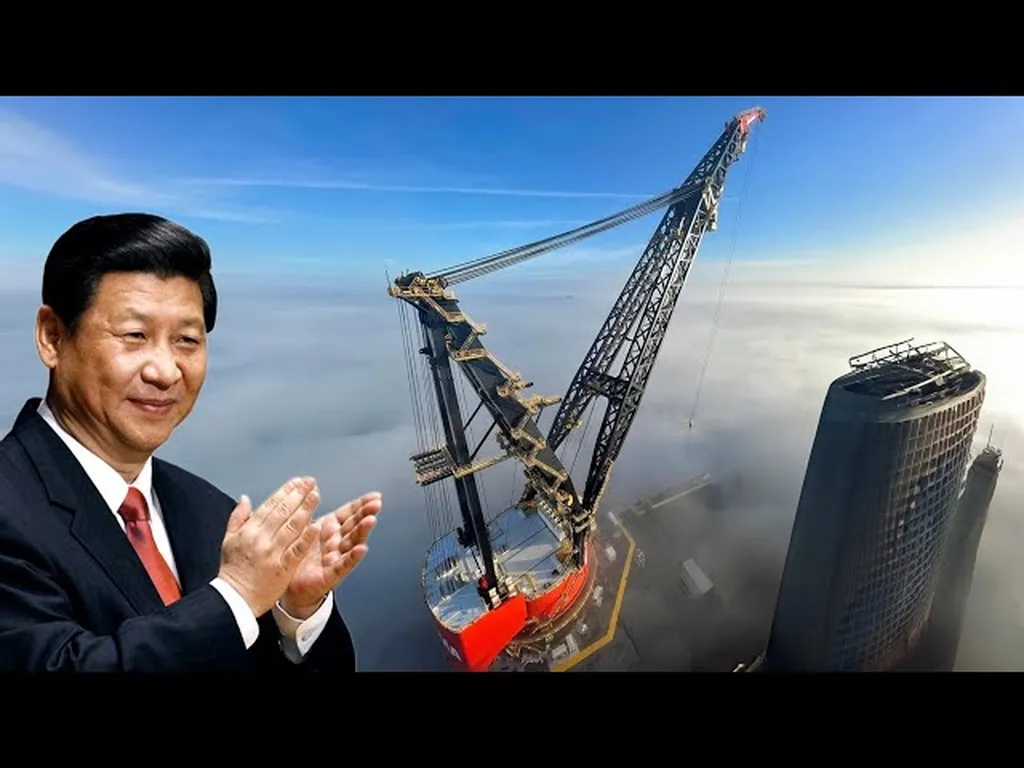
In the heart of China’s rapid urbanization, a towering challenge has emerged: how to safely construct super-tall buildings that reach for the skies. At the forefront of this challenge is the use of large external hanging jib tower cranes, and a recent study published in the *Advances in Civil Engineering* (translated from Chinese as “Advances in Civil Engineering”) is shedding new light on their critical anchorage systems. The research, led by Pengfei Li from the Office of General Affairs, is set to reshape the way we approach the construction of ultrahigh-rise buildings, with significant implications for the energy sector and beyond.
The study, which focused on the ZSL1700 tower crane used in the construction of the 428-meter Greenland Shandong International Financial Center (IFC), reveals that conventional design assumptions may not be capturing the full picture. “We’ve always assumed that the forces are evenly distributed,” Li explains, “but our findings show that’s not quite the case.”
By combining field monitoring with advanced numerical simulation, Li and his team discovered that the lower attachment frame of the crane bears significantly larger forces than the upper frame. Moreover, they found that critical stress peaks occur at specific rotation angles, with vertical forces creating unfavorable bending moments at the tower base. “This is crucial information for optimizing anchorage systems and enhancing structural safety,” Li emphasizes.
The study also highlights the impact of wind direction on the crane’s forces. When the wind is parallel to the crane’s jib, forces increase by approximately 22%, underscoring the importance of wind considerations in design. This finding is particularly relevant for the energy sector, where wind loads can significantly impact the efficiency and safety of construction projects.
The research is expected to shape future developments in the field, with potential applications in the design and construction of not just super-tall buildings, but also other large-scale structures. By providing a deeper understanding of the forces at play, this study is paving the way for more efficient, safer, and cost-effective construction practices.
As cities continue to grow upwards, the insights gained from this research will be invaluable. “Our goal is to ensure that as we reach for the skies, we do so with a solid foundation,” Li concludes. With this study, that foundation has become a little bit stronger.