
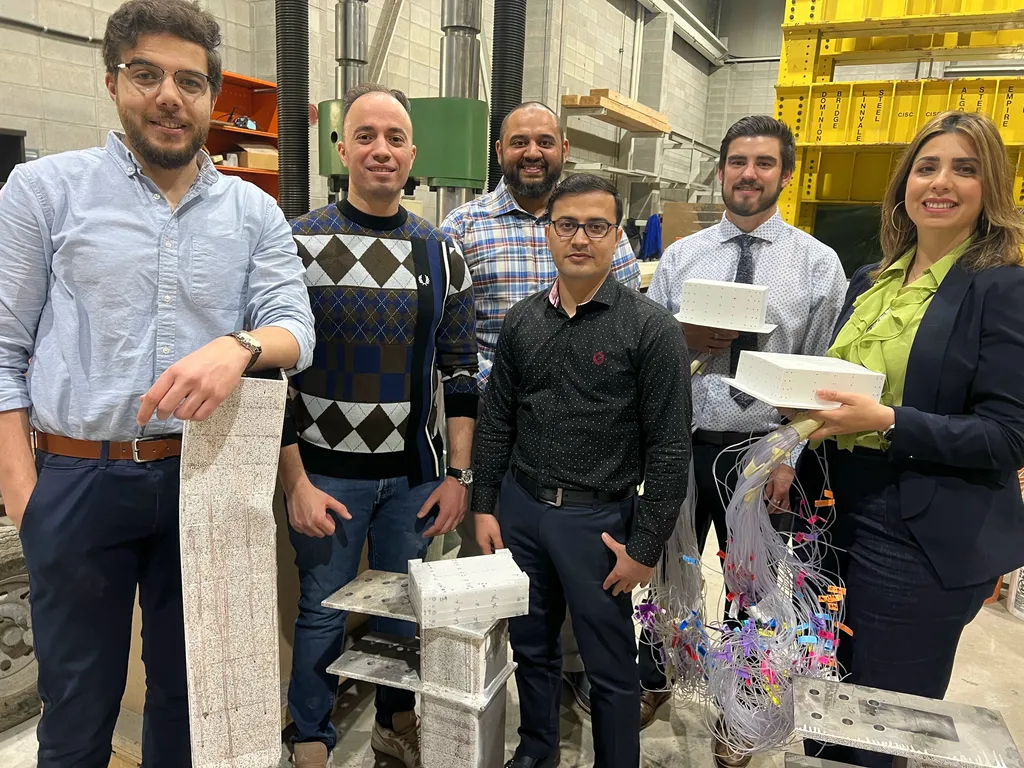
In the quest to address Canada’s persistent housing shortage, particularly in remote Indigenous communities, a novel steel connection for panelized modular houses is emerging as a game-changer. Mostafa Elhadary, a researcher from the Department of Civil Engineering at Lakehead University in Thunder Bay, ON, has spearheaded a study that could revolutionize modular construction, making it more efficient, durable, and adaptable to challenging environments.
Elhadary’s research, published in the journal ‘Frontiers in Built Environment’ (translated to ‘Frontiers in the Built Environment’), focuses on an innovative steel bolted connection using hollow structural sections (HSS). This design aims to overcome the transportation and lifting challenges that have historically hindered the widespread adoption of modular construction. “The goal was to develop a connection that not only enhances structural performance but also improves constructability,” Elhadary explained.
The study involved extensive experimental testing and validation using three-dimensional finite element models. A parametric study on one- and two-dimensional prototypes examined various factors influencing the connection’s structural performance, including stiffeners, bolt arrangement, bolt number, and plate thickness.
The findings are promising. For instance, the AR1.5 bolt arrangement increased capacity through early bolt bearing but reduced ultimate rotation by 50%. Conversely, the AR0.6 arrangement shifted failure to the column due to local buckling. Increasing plate thickness from 10 mm to 15 mm boosted capacity by up to 7% and ductility by 11%. Moreover, increasing the number of bolts from six to ten improved capacity by up to 22%, depending on the arrangement. The addition of a 10-mm stiffener, however, reduced ultimate rotation by approximately 60% due to local buckling.
These insights highlight the critical role of bolt configuration and reinforcement techniques in optimizing both strength and deformation capacity. “Our findings provide guidance for the design of efficient and durable modular housing connections,” Elhadary noted.
The commercial implications for the energy sector are significant. Modular construction is increasingly being used for remote energy projects, where rapid deployment and minimal site disruption are crucial. This innovative connection could enhance the feasibility and cost-effectiveness of such projects, making them more attractive to investors and developers.
As the demand for sustainable and efficient construction methods grows, Elhadary’s research offers a compelling solution. By addressing the unique challenges of remote and Indigenous communities, this study not only advances the field of modular construction but also contributes to broader societal goals of equity and sustainability.
In the words of Elhadary, “This research is a step towards making modular housing more accessible and resilient, ultimately benefiting communities that need it most.” As the industry continues to evolve, this innovative connection could become a cornerstone of future developments, shaping the way we build and live.