
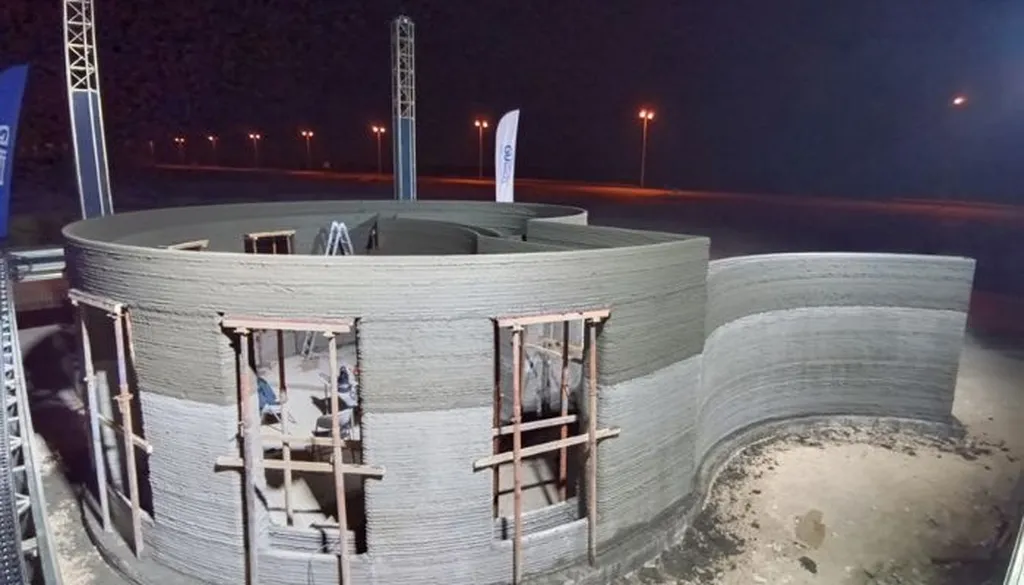
In a groundbreaking development poised to reshape the construction industry, researchers have unveiled a novel composite beam system that marries the strengths of 3D-printed concrete (3DPC) and glued laminated timber (GLT), all while eschewing traditional steel reinforcement. This innovative approach, detailed in a study published in the journal *Case Studies in Construction Materials* (translated from Chinese as “典型案例:建筑材料”), could have significant implications for the energy sector, particularly in the design and construction of sustainable, high-performance structures.
At the heart of this research is Xiaoyue Zhang, a leading civil engineering expert from Chongqing University in China. Zhang and her team have tackled a longstanding challenge in composite construction: the effective bonding between dissimilar materials. Their solution? An ultra-high-performance concrete (UHPC)-filled notch-screw shear connector that not only enhances load-bearing capacity but also improves slip stiffness.
“The key was optimizing the connector’s design and the interface between the 3DPC and UHPC,” Zhang explained. “We found that the notch depth and length played crucial roles in performance, while the shear length ahead of the notch had a minor influence.”
The study identified three failure modes at the critical 3DPC-UHPC interface, with performance heavily dependent on matrix interlayer properties and interface morphology. The X-interface, which retained the original 3DPC surface, proved to be the most effective. Additionally, the team discovered that adding polyoxymethylene fiber further enhanced performance, and connectors with a vertical printing path outperformed those with a horizontal path by approximately 8%.
Bending tests on the composite beams revealed that those with a transverse mesh exhibited 28.8% greater initial stiffness than those with a top-surface mesh. This finding underscores the importance of cross-sectional mesh configuration in achieving optimal structural performance.
“Our system achieved satisfactory structural performance without traditional steel reinforcement,” Zhang noted. “This validates the feasibility of our reinforcement-free, prefabricated approach.”
The research also demonstrated that predictions for bending stiffness and interface shear capacity, based on the gamma method, showed good agreement with experimental values. This alignment between theory and practice paves the way for broader adoption of the technology.
The implications for the energy sector are profound. As the push for sustainable construction gains momentum, the ability to integrate 3DPC and GLT in a reinforcement-free system could lead to more energy-efficient buildings with lower carbon footprints. The potential for reduced material waste and faster construction times could also translate into significant cost savings.
“This research opens up new possibilities for the design and construction of high-performance structures,” Zhang said. “It’s a step towards a more sustainable and efficient future for the construction industry.”
As the world grapples with the challenges of climate change and resource depletion, innovations like Zhang’s composite beam system offer a glimmer of hope. By pushing the boundaries of what’s possible in construction, researchers are not only advancing the field but also contributing to a more sustainable future for all.
In the quest for greener, more efficient construction methods, this study stands as a testament to the power of innovation and the potential of interdisciplinary collaboration. As the industry continues to evolve, the insights gleaned from this research are likely to shape future developments, driving the construction sector towards a more sustainable and resilient future.