
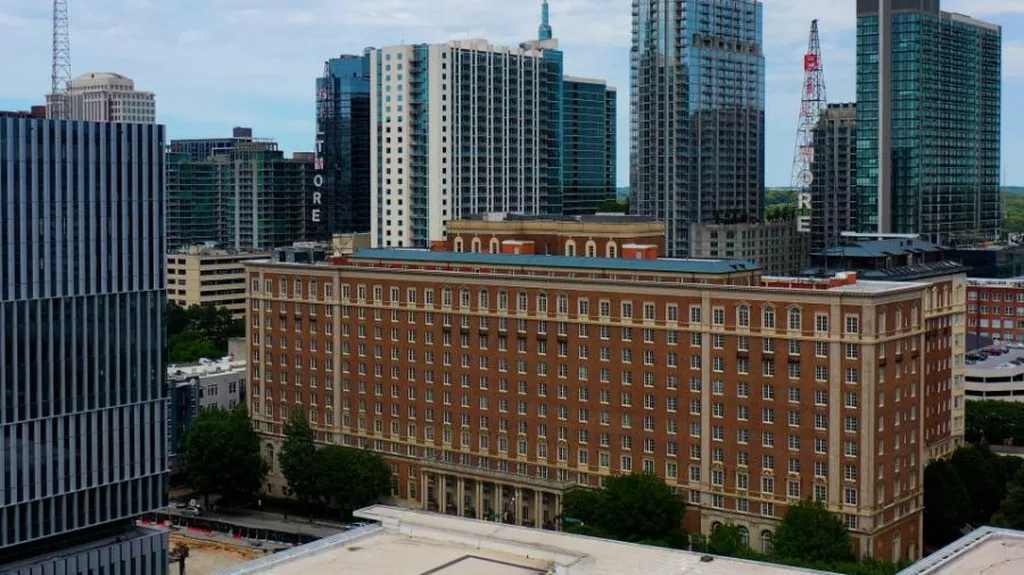
In the heart of Atlanta’s Sweet Auburn National Historic Landmark District stands the Odd Fellows Building, a century-old structure that has witnessed the city’s evolution. Today, it’s not just the building’s history that’s making waves, but the innovative digital transformation techniques being employed to breathe new life into it. At the forefront of this endeavor is Botao Li, a researcher from the School of Architecture at Georgia Institute of Technology, who has pioneered a multi-device scan-to-HBIM workflow that’s setting new standards in adaptive reuse and digital documentation.
The Odd Fellows Building, with its seven stories and a basement, is a complex structure that demands precise documentation and efficient stakeholder communication. Li and his team faced strict time and funding limits, which necessitated a creative approach to data collection. They integrated Terrestrial Laser Scanning (TLS), Matterport 360-camera technology, and Unmanned Aerial Vehicles (UAVs) to create an efficient and accessible pipeline for documenting historic buildings.
Li explains, “We employed TLS as a benchmark capture method to establish a baseline point cloud for aligning all other data. Matterport technology enabled fast interior scanning while providing high-resolution visuals and an interactive virtual tour platform. UAVs were deployed to supplement data collection in hard-to-access exterior areas.”
This multi-device strategy optimizes the trade-off between capture speed and spatial tolerance, accommodating a complex mix of preserved historic elements and altered upper floors. The resulting data is processed and registered to provide one combined point cloud, which is integrated into a semantically rich Heritage Building Information Modeling (HBIM) model developed in Autodesk Revit at Level of Development (LoD) 300.
The implications of this research extend beyond the Odd Fellows Building. By demonstrating how different reality capture technologies can be effectively integrated to accommodate site limitations, stakeholder needs, and funding constraints, this case study contributes to the broader discourse on digital transformation in construction. It highlights the evolving intersection of BIM, remote visualization, and the early stages of Digital Twin (DT) development in the preservation sector.
For the energy sector, the commercial impacts are significant. The ability to remotely revisit and analyze spaces without geographic limitation can revolutionize energy audits, retrofitting projects, and maintenance planning. It offers a cost-effective and efficient way to document and manage energy-related infrastructure, ultimately contributing to sustainability goals.
As Li’s work is published in the journal *Frontiers in Built Environment* (translated to English as “Frontiers in the Built Environment”), it serves as a testament to the power of innovation in preserving our built heritage. The research not only provides a practical solution for adaptive reuse but also lays the groundwork for future developments in digital documentation and remote visualization.
In an era where technology and history intersect, Li’s work stands as a beacon of progress, illuminating the path towards a future where our past is preserved with the tools of tomorrow. As the construction industry continues to evolve, the lessons learned from the Odd Fellows Building will undoubtedly shape the way we approach historic preservation and digital transformation.