
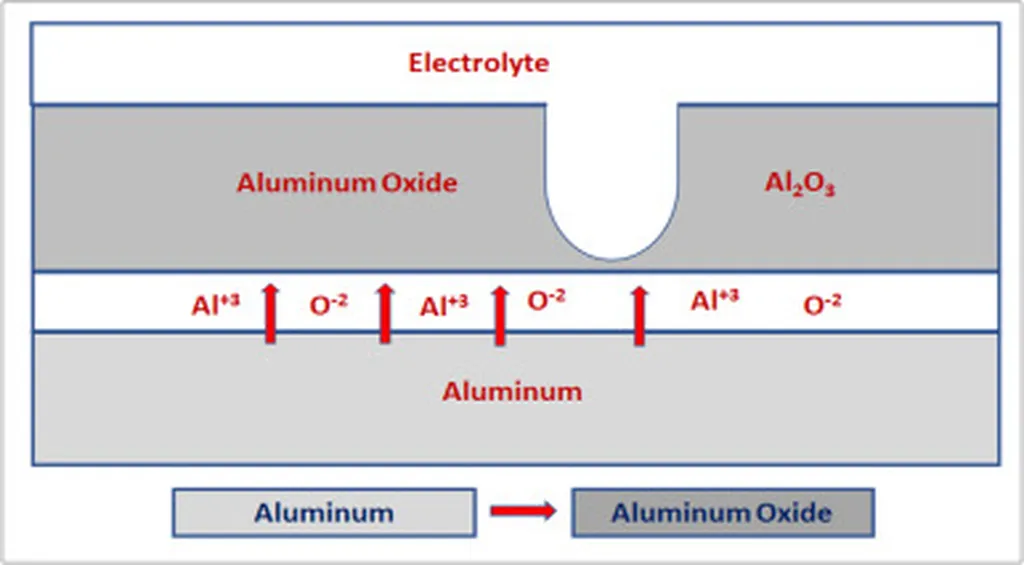
In the quest to engineer advanced materials for energy applications, a team of researchers from the Jagiellonian University in Krakow, Poland, has made a significant stride. Led by Aleksandra Świerkula from the Department of Physical Chemistry and Electrochemistry, the study, published in the Journal of Physics Materials (JPhys Materials), explores the use of sulfuric and oxalic acid mixtures to create anodic aluminum oxide (AAO) layers with tailored channel geometries. This research could have profound implications for the energy sector, particularly in the development of more efficient energy storage and conversion devices.
The study focuses on the influence of electrolyte composition on the morphology and growth kinetics of AAO layers. By varying the composition of H₂C₂O₄–H₂SO₄ mixtures, the researchers were able to control the pore size, porosity, and structural order of the AAO layers. “The presence of sulfuric acid significantly affects both the oxide growth rate and pore formation and reorganization,” explains Świerkula. “At higher potentials, it promotes the development of AAO layers with larger pore diameters and higher porosity, which is attributed to enhanced oxide etching.”
The ability to fine-tune the morphological features of porous alumina layers opens up new possibilities for their application in energy devices. For instance, AAO layers with highly ordered branched channels could enhance the performance of supercapacitors, batteries, and fuel cells by providing a larger surface area for electrochemical reactions. “The potential application of H₂C₂O₄–H₂SO₄ mixtures for the fabrication of AAO layers with highly ordered branched channels has been demonstrated,” notes Świerkula. “This represents a promising strategy for engineering the morphological features of porous alumina layers.”
The research was conducted using aqueous and water–ethanol solutions under low-temperature conditions, with applied voltages ranging from 25 to 35 V. The findings suggest that the composition of acid mixtures plays a crucial role in determining the final properties of AAO layers. By optimizing the electrolyte composition, researchers can tailor the AAO layers to meet specific requirements for various energy applications.
The study’s implications extend beyond the energy sector. The ability to control the morphology of AAO layers could also benefit fields such as catalysis, sensing, and filtration. As the demand for more efficient and sustainable energy solutions continues to grow, the development of advanced materials like AAO layers will be crucial. This research represents a significant step forward in that direction.
In the words of Świerkula, “Fine-tuning the composition of acid mixtures represents a promising strategy for engineering the morphological features of porous alumina layers.” With further research and development, this approach could lead to the creation of next-generation energy devices with enhanced performance and efficiency. The study, published in JPhys Materials, is a testament to the power of interdisciplinary research in driving technological innovation.