
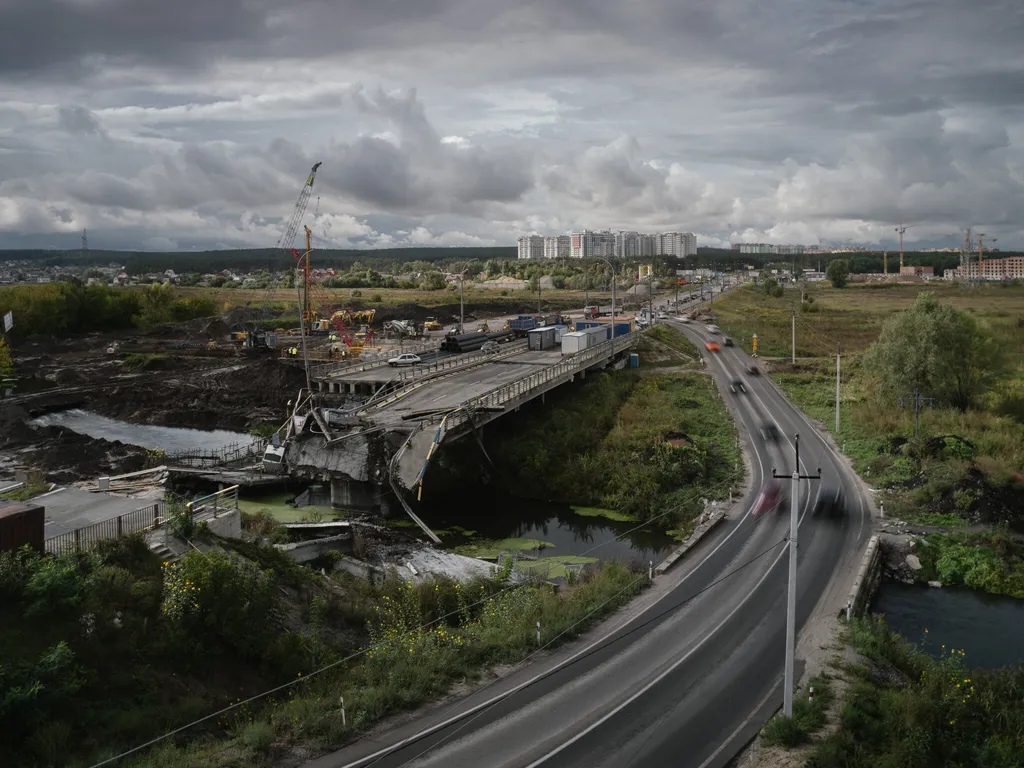
In the ever-evolving world of infrastructure and transportation, a groundbreaking methodology has emerged that could significantly enhance the durability of road surfaces on metal highway bridges. This innovative approach, developed by Artur Onyshchenko of the National Transport University in Kyiv, Ukraine, focuses on calculating thermal stresses in asphalt concrete road pavements, a critical factor in the longevity of these structures.
Highway bridges are the arteries of our transport network, facilitating the movement of goods and people across vast distances. However, they operate under increasingly challenging conditions. As Onyshchenko notes, “Every year, thousands of new vehicles appear in Ukraine, leading to changes in traffic flows, increased load capacity, and higher speeds.” This surge in traffic, coupled with the unique thermal dynamics of metal orthotropic bridges, necessitates a more robust approach to pavement design.
The traditional road surfaces on metal highway bridges are subjected to more adverse conditions than their non-rigid counterparts on highways. They must withstand not only the mechanical stresses from traffic but also the thermal stresses caused by daily and annual temperature fluctuations. These thermal stresses can lead to cracking, compromising the integrity of the pavement and reducing its lifespan.
Onyshchenko’s methodology addresses these challenges head-on. By incorporating materials science and design approaches, it enables the creation of road pavements with increased crack resistance. This is a game-changer for the industry, as it allows for the design of pavements that can better withstand the thermal stresses and, consequently, last longer.
The implications of this research are far-reaching, particularly for the energy sector. Durable road surfaces mean reduced maintenance costs and less frequent closures for repairs, ensuring the smooth flow of traffic and the efficient transport of goods. This is crucial for the energy sector, which relies on the timely delivery of resources and equipment.
Moreover, the methodology contributes to the rational use of economic resources. By extending the lifespan of road pavements, it reduces the need for frequent and costly repairs, leading to significant savings in the long run.
Published in the journal ‘Дороги і мости’ (translated to English as ‘Roads and Bridges’), this research is set to shape future developments in the field. It offers a promising solution to a longstanding problem, paving the way for more resilient and durable infrastructure.
As we look to the future, the need for innovative solutions in infrastructure design and maintenance will only grow. Onyshchenko’s work is a testament to the power of research and innovation in addressing these challenges. It is a reminder that, with the right approach, we can build structures that stand the test of time and the elements.