
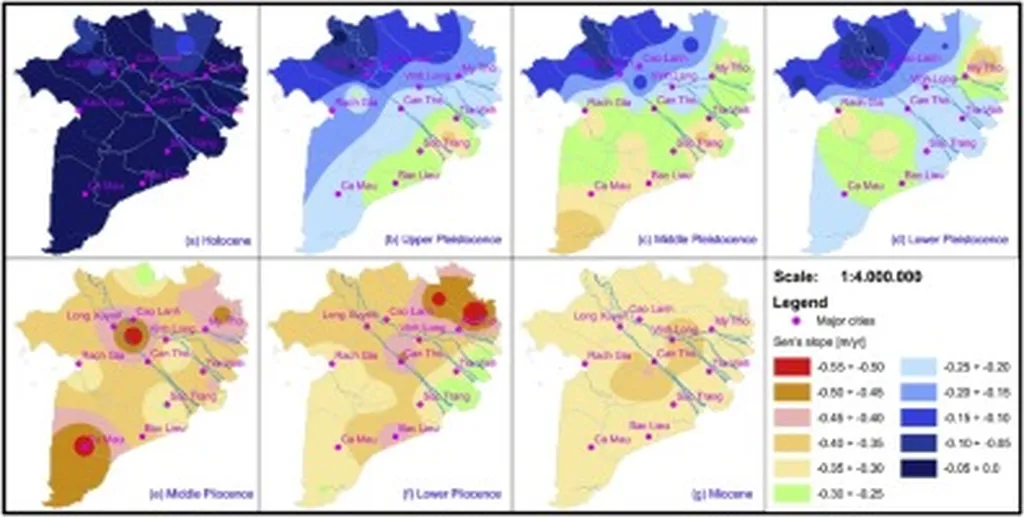
In the heart of Vietnam’s Mekong Delta, a region teeming with life and agricultural bounty, a silent transformation is underway. Over the past three decades, the landscape has been subtly reshaped by human hands, and now, a new study sheds light on the profound implications of these changes. Led by Emiliana Valentini of the Institute of Polar Sciences at the National Research Council of Italy (ISP CNR) in Rome, the research, published in the journal Environmental Research Letters (or Letters in Environmental Research in English), delves into the intricate relationship between land use changes and evapotranspiration (ET), a critical process in the water cycle.
The Mekong Delta, nestled between the Mekong and Bassac rivers, is a vital agricultural hub. However, the construction of new urban areas, upstream dam operations, and the conversion of natural areas to aquaculture have fragmented the landscape and altered the region’s water balance. Valentini and her team employed a synthesis approach, utilizing the Soil and Water Assessment Tool (SWAT) hydrological model to analyze the evolution of ET from 1990 to 2020.
Their findings reveal a stark trend: a decrease in ET, closely linked to the reduction of water surfaces due to dam operations and urban expansion. “The increase in landscape fragmentation has led to a significant decrease in evapotranspiration,” Valentini explains. This reduction in ET can have far-reaching consequences, affecting everything from agricultural productivity to energy generation.
For the energy sector, understanding these changes is crucial. Hydropower plants, which rely on consistent water flow, may face challenges as the water cycle is disrupted. Additionally, changes in ET can influence local climate patterns, impacting solar and wind energy potential. As Valentini notes, “The conversion of natural areas to aquaculture in coastal regions has led to a slight increase in ET, but the overall trend is a decrease.”
This research underscores the importance of sustainable land use planning and the need for integrated water resource management. As the Mekong Delta continues to evolve, so too must our understanding of its complex hydrological dynamics. Valentini’s work serves as a call to action, urging stakeholders to consider the long-term impacts of land use changes on the region’s water balance and, by extension, its economic and environmental health.
The study not only highlights the need for careful management of the Mekong Delta’s resources but also offers a valuable framework for similar regions around the world. As climate change and human activity continue to reshape our landscapes, understanding the interplay between land use and hydrological processes will be key to ensuring a sustainable future. Valentini’s research provides a vital stepping stone in this ongoing journey of discovery and adaptation.