
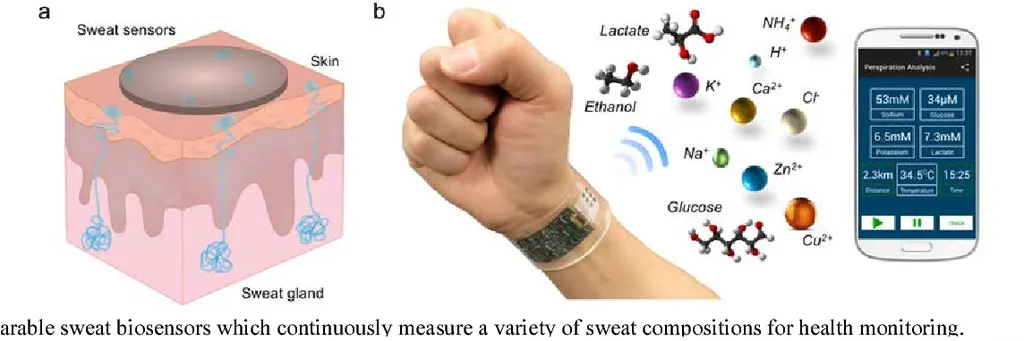
In a significant stride towards personalized healthcare, researchers have developed a novel wearable electrochemical sensor that could revolutionize the way we monitor vital biomarkers. The sensor, based on laser-induced graphene (LIG) and integrated into a commercial adhesive bandage, is capable of simultaneously detecting uric acid (UA) and ascorbic acid (AA) in sweat. This innovation, led by Leyllanne K. A. Souza of the Instituto de Química at Universidade Federal de Goiás in Brazil and the Department of Chemistry at Colorado State University, opens up new avenues for continuous, non-invasive health monitoring.
The sensor’s unique design leverages the properties of laser-induced graphene, a material known for its conductivity and biocompatibility. “The carbon-rich, homogeneous morphology of the LIG electrodes enhances analyte interaction, making the sensor highly sensitive and reliable,” explains Souza. The device’s repeatability and reproducibility are impressive, with relative standard deviations (RSD) of just 2.7% and 8.2%, respectively.
The sensor’s analytical performance is equally noteworthy. Using differential pulse voltammetry (DPV) measurements in phosphate-buffered saline (PBS), the device demonstrated a linear response from 20 to 200 μmol l^−1 for both AA and UA, with limits of detection (LOD) of 6.6 μmol l^−1 and 6 μmol l^−1, respectively. When tested in artificial sweat, the sensor showed minimal interference (<10%) and recoveries ranging from 96% to 100% for AA and 90% to 115% for UA. The implications of this research are far-reaching. "This low-cost, flexible sensor could serve as a practical platform for biofluid analysis, facilitating home-based healthcare and reducing the reliance on costly laboratory tests," says Souza. The sensor's potential extends beyond personal health monitoring. In the energy sector, for instance, continuous health monitoring of workers in high-stress environments could enhance safety and productivity. The research was recently published in 'ECS Sensors Plus', an open-access journal dedicated to the advancement of sensor technology. As the world moves towards a future of personalized and preventive healthcare, innovations like this wearable sensor are poised to play a pivotal role. The sensor's low cost (approximately US$0.5 per unit) and ease of use make it an attractive option for widespread adoption, potentially reshaping the landscape of health monitoring and diagnostics. This breakthrough underscores the importance of interdisciplinary research and collaboration. By combining expertise in chemistry, materials science, and engineering, Souza and her team have developed a device that could significantly impact the lives of millions. As the technology continues to evolve, we can expect to see even more innovative applications emerge, further enhancing our ability to monitor and maintain our health.