
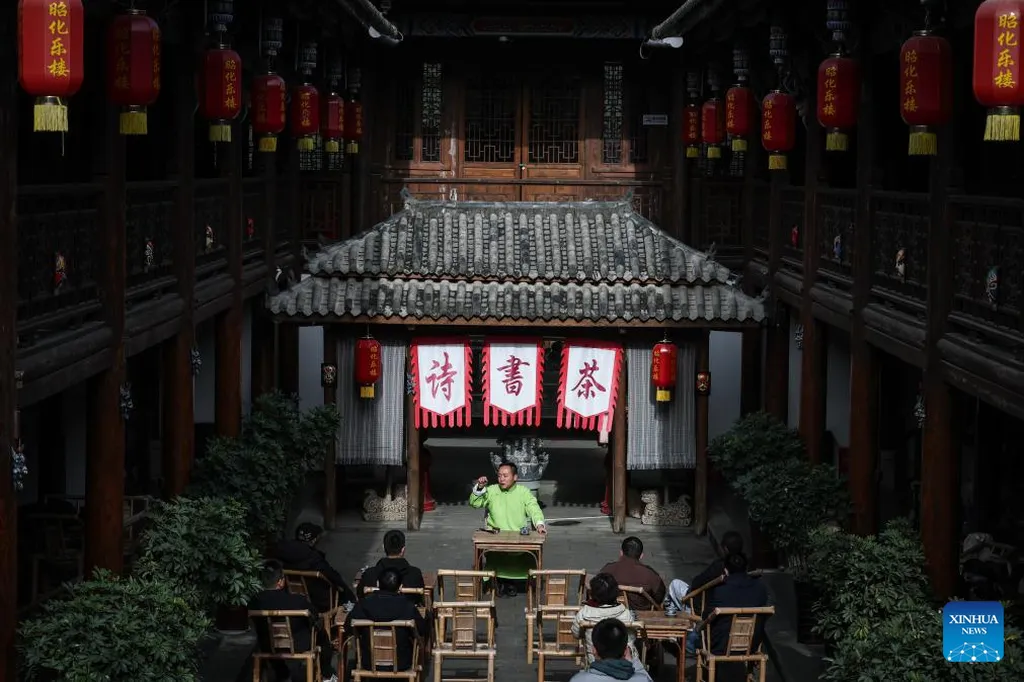
In the heart of China’s rural revitalization efforts, a groundbreaking study led by Jiayi Liu from Anhui Polytechnic University is shedding new light on how to preserve intangible cultural heritage (ICH) through traditional village tourism. The research, published in the *Journal of Asian Architecture and Building Engineering* (known in English as the *Journal of Asian Architecture and Building Engineering*), explores the “sojourning” model—a concept that encourages visitors to immerse themselves in local culture and traditions—and its impact on visitors’ intentions to support ICH.
Liu and his team delved into the behavioral intentions of visitors to traditional villages, using a combination of social media big data analysis and resident perception measurement. They identified three key dimensions that influence visitors’ perceptions: Rural Image Perception (RIP), Social Image Perception (SIP), and Ecological Image Perception (EIP). These dimensions were extracted using the Latent Dirichlet Allocation (LDA) topic model, a sophisticated statistical tool that uncovers hidden topics in large datasets.
The study’s findings are compelling. The sojourning model significantly enhances visitors’ identification with ICH and local culture, strengthening their intention to support it. “The sojourning model creates a deeper connection between visitors and the local culture,” Liu explains. “This connection is crucial for fostering a sense of ownership and responsibility towards preserving intangible cultural heritage.”
The research also ranked the relative importance of influencing factors. Cultural Value Perception (CVP) emerged as the most influential factor, followed by Perceptual Integration (PI), Emotional Integration (EI), SIP, RIP, and EIP (least influential). This hierarchy provides valuable insights for tourism developers and policymakers, highlighting the aspects of the sojourning model that need to be prioritized.
The study’s implications are far-reaching. By understanding the mechanisms through which visitors form cultural support behavioral intention, tourism developers can design more effective strategies for preserving ICH. This is particularly relevant in the context of rural revitalization, where traditional villages are increasingly becoming tourist destinations.
Moreover, the use of advanced analytical tools like Structural Equation Modeling (SEM) and Artificial Neural Network (ANN) models in this study sets a new standard for research in this field. These tools enable a more nuanced understanding of complex relationships and interactions, paving the way for more sophisticated and effective strategies.
As Liu puts it, “This research is not just about understanding visitor behavior. It’s about creating a sustainable future for traditional villages and their intangible cultural heritage.” The study’s findings could shape future developments in the field, guiding the creation of tourism models that are not only commercially viable but also culturally and ecologically sustainable.
In the broader context of the energy sector, this research underscores the importance of integrating cultural and ecological considerations into development strategies. As the world grapples with the challenges of climate change and cultural preservation, the insights from this study could prove invaluable. They could guide the development of energy projects that are not only efficient and sustainable but also respectful of local cultures and traditions.
In conclusion, Liu’s research is a significant step forward in the field of traditional village tourism and ICH preservation. It provides a robust theoretical framework and practical insights that could shape the future of rural revitalization and cultural preservation efforts. As the world increasingly turns to sustainable and culturally sensitive development models, this research could not be more timely or relevant.