
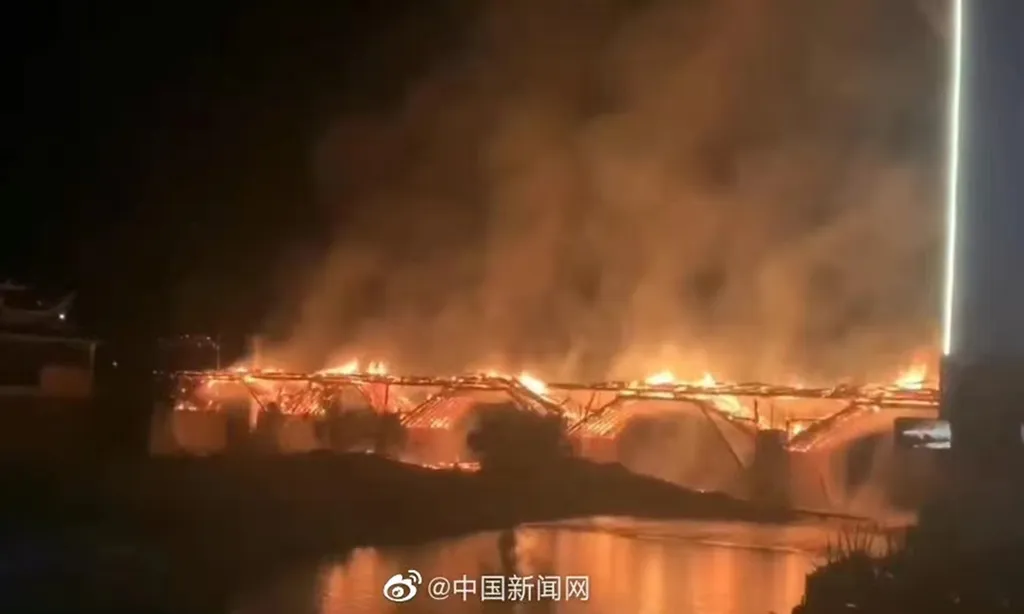
In the heart of Zhejiang Province, China, stands the Liuzhai Bridge, a timber lounge bridge that serves as a vital cultural heritage structure. Yet, its intricate timber structures and combustible materials make it highly vulnerable to fire. This challenge has led researchers to innovate in the field of fire risk assessment, with a recent study published in the *Journal of Asian Architecture and Building Engineering* (translated as *Journal of Asian Architecture and Building Engineering*) offering a promising solution.
The study, led by Chang Su of Shanghai Jiaotong University, introduces a novel framework for fire risk assessment using Fuzzy Bayesian Networks (FBN). This approach addresses the complexities and uncertainties inherent in assessing fire risks for such structures.
“Timber lounge bridges are not only culturally significant but also highly complex in terms of their structural and environmental factors,” Su explains. “Traditional risk assessment methods often fall short due to information uncertainty and limited data availability. Our study aims to bridge this gap by leveraging fuzzy probabilistic modeling.”
The research establishes a hierarchical indicator system that includes ignition sources, structural vulnerabilities, and emergency response capacities. By modeling risk failure propagation, the study provides a comprehensive assessment of fire risks. Prior probabilities are derived from expert judgments through triangular fuzzy numbers and similarity aggregation, while conditional relationships are quantified using the noisy-OR model.
The model’s effectiveness was validated through a case study of the Liuzhai Bridge, estimating a fire risk probability of 17% and identifying key sensitive factors and major risk failure propagation pathways. The results align well with on-site risk characteristics, demonstrating the model’s practicality for early warning, risk prediction, and targeted mitigation strategies.
“This study shows that fuzzy probabilistic modeling provides a practical framework for early warning, risk prediction, and targeted mitigation strategies in timber heritage preservation,” Su notes. “It offers a robust tool for stakeholders to make informed decisions and implement effective fire safety measures.”
The implications of this research extend beyond cultural heritage preservation. In the energy sector, where timber structures are increasingly being considered for sustainable and eco-friendly construction, the FBN framework could play a crucial role in ensuring safety and mitigating risks. By providing a clear and comprehensive assessment of fire risks, this approach can guide the development of safer and more resilient structures.
As the world continues to prioritize sustainability and cultural preservation, the work of Su and his team offers a valuable contribution to the field. By integrating advanced probabilistic modeling with expert knowledge, this research paves the way for more effective risk management strategies, benefiting not only cultural heritage sites but also the broader construction and energy sectors.
In an era where data-driven decision-making is paramount, the FBN framework stands as a testament to the power of innovative research in addressing complex challenges. As Su and his colleagues continue to refine and expand this methodology, its impact on the preservation of timber structures and the advancement of fire safety measures is poised to grow, shaping the future of the construction and energy industries.