
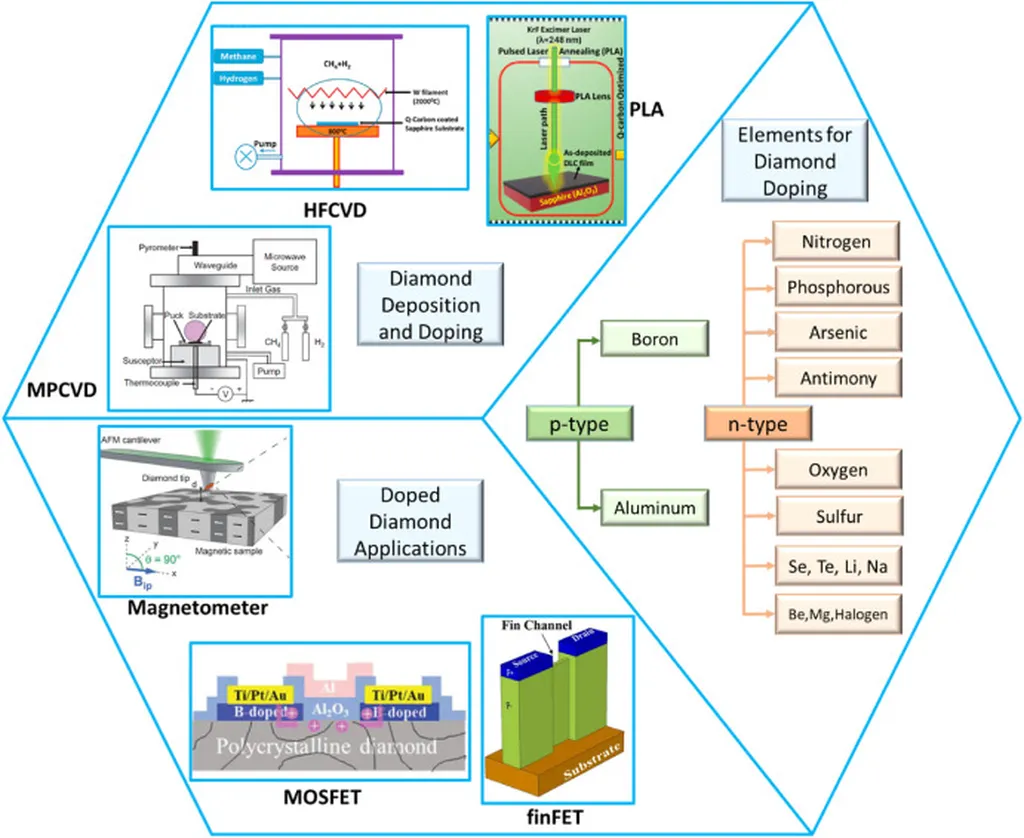
In a groundbreaking study published in the journal *Functional Diamond* (translated from Chinese), researchers have uncovered a promising method to enhance the performance of diamond-based electronic devices, a discovery that could revolutionize the energy sector. The research, led by Cong Li of the State Key Lab of High Pressure and Superhard Materials at Jilin University, focuses on achieving efficient p-type conductivity in diamond, a critical factor for developing high-power and high-frequency electronic devices.
Diamond, known for its exceptional thermal conductivity and electrical insulation properties, has long been touted as a potential material for high-performance electronics. However, achieving efficient p-type conductivity—the ability to conduct electricity through positively charged holes—has been a significant challenge. This new study employs first-principles calculations to evaluate beryllium (Be) as a p-type dopant in diamond and explores the synergistic effects of nitrogen (N)-Be co-doping.
The findings are nothing short of transformative. High-concentration Be doping can significantly reduce the acceptor ionization energy to 0.35 eV, making it easier to activate the dopants and achieve p-type conductivity. But the real breakthrough comes with N-Be co-doping. “N-4Be co-doped structure shows the reduced formation energy of 3.37 eV and acceptor ionization energy as low as 0.30 eV,” Li explains. This substantial reduction in both defect formation energies and acceptor ionization energies paves the way for more efficient and stable p-type diamond semiconductors.
The implications for the energy sector are profound. High-performance diamond-based electronic devices could lead to more efficient power conversion and management systems, crucial for renewable energy integration and grid stability. “This research suggests the potential for exploring donor–acceptor co-doping to achieve efficient p-type conductivity,” Li adds, hinting at a broader application of these findings beyond just diamond.
The study not only advances our understanding of diamond doping but also opens up new avenues for experimental research. By demonstrating the feasibility of N-Be co-doping, the researchers have provided a roadmap for future developments in diamond-based electronics. As the energy sector continues to demand more efficient and reliable materials, this research could be a game-changer, driving innovation and shaping the future of high-power and high-frequency electronic devices.
With the publication of this study in *Functional Diamond*, the scientific community now has a clearer path forward. The next steps involve experimental validation and further exploration of co-doping strategies, but the potential is undeniable. As Cong Li and his team continue to push the boundaries of material science, the energy sector stands to benefit immensely, heralding a new era of high-performance electronics.