
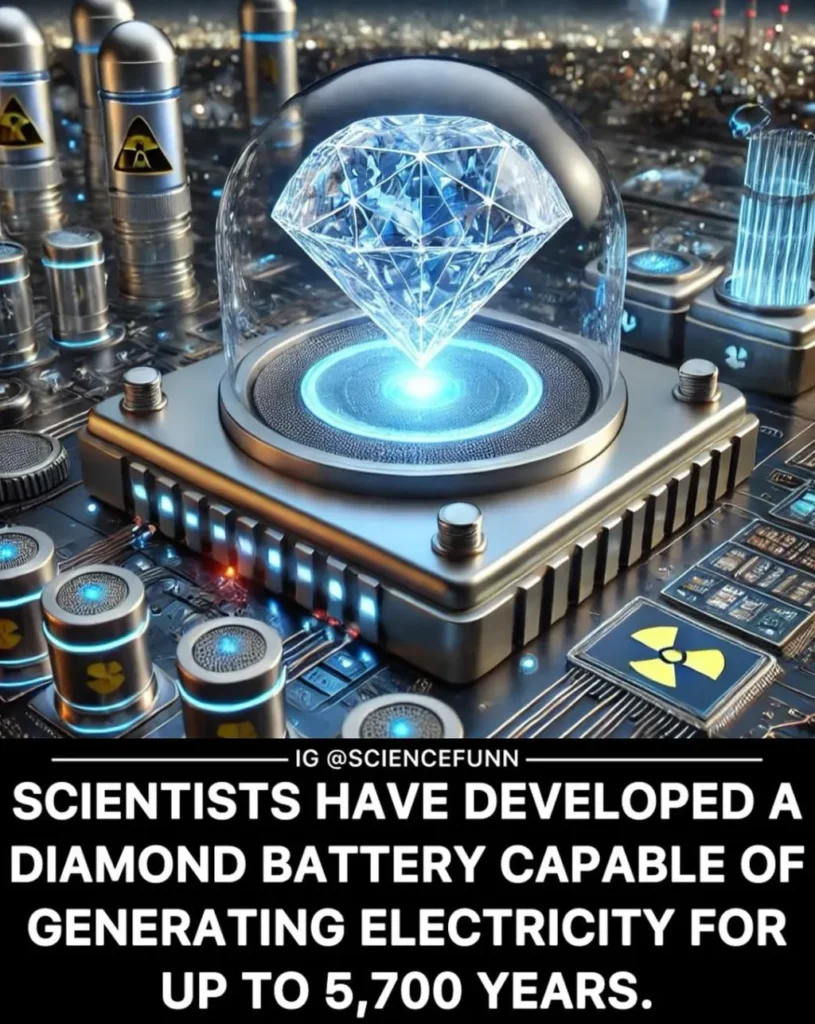
In the quest for innovative energy solutions, researchers have turned to an unconventional yet promising technology: nuclear batteries. Unlike traditional batteries, these devices harness the energy of radioactive decay, offering a long lifespan, stable output, and high energy density. Now, a groundbreaking study published in the journal *Functional Diamond* (translated from Chinese) has highlighted the potential of diamond as a key material in the development of these next-generation power sources.
Led by Xu Han from the Laboratory of Solid-State Optoelectronic Information Technology at the Institute of Semiconductors, Chinese Academy of Sciences, the research delves into the unique properties of diamond that make it an ideal candidate for nuclear batteries. “Diamond is an ultra-wide band gap semiconductor with high carrier mobilities and high chemical inertness,” explains Han. “More importantly, it is an excellent radiation resistance material, which is crucial for the fabrication of nuclear batteries.”
Nuclear batteries, also known as radioisotope batteries, convert the energy of high-energy particles into electrical energy. They consist primarily of a radioisotope and a semiconductor energy converter. The radioisotope undergoes radioactive decay, releasing particles that are absorbed by the semiconductor, generating an electric current. This process offers several advantages over conventional batteries, including a longer lifespan and the ability to operate in harsh environments.
The study reviews the development status of diamond-based nuclear batteries, focusing on three types: alpha-voltaic, beta-voltaic, and gamma-voltaic nuclear batteries. Each type utilizes different radioactive particles for energy conversion, but all benefit from diamond’s exceptional properties. “Diamond’s radiation resistance ensures that the semiconductor converter remains functional for extended periods, even under intense radiation,” Han notes.
The commercial implications of this research are substantial. Nuclear batteries have the potential to revolutionize the energy sector, particularly in applications where traditional batteries fall short. For instance, they could power remote sensors, medical devices, and space exploration equipment, where long lifespans and reliability are paramount. Additionally, their high energy density makes them suitable for compact, high-power applications.
Looking ahead, the research provides an outlook on future developments in diamond-based nuclear batteries. Han envisions advancements in material science and semiconductor technology that could further enhance the efficiency and performance of these devices. “As we continue to explore the unique properties of diamond and other advanced materials, we anticipate significant progress in the field of nuclear batteries,” he says.
The study published in *Functional Diamond* marks a significant step forward in the development of nuclear batteries. By leveraging the exceptional properties of diamond, researchers are paving the way for a new era of energy solutions that are reliable, long-lasting, and capable of operating in extreme conditions. As the energy sector continues to evolve, the insights gained from this research could shape the future of power generation and storage, offering innovative solutions to meet the world’s growing energy demands.