
In a breakthrough that could reshape the landscape of hydrogen storage, researchers from Fudan University in Shanghai have developed a novel catalyst that significantly enhances the performance of magnesium-based hydrogen storage materials. The study, led by Xuechun Hu from the College of Smart Materials and Future Energy, was recently published in the journal Sustainable Materials (SusMat), which translates to English as “SusMat”.
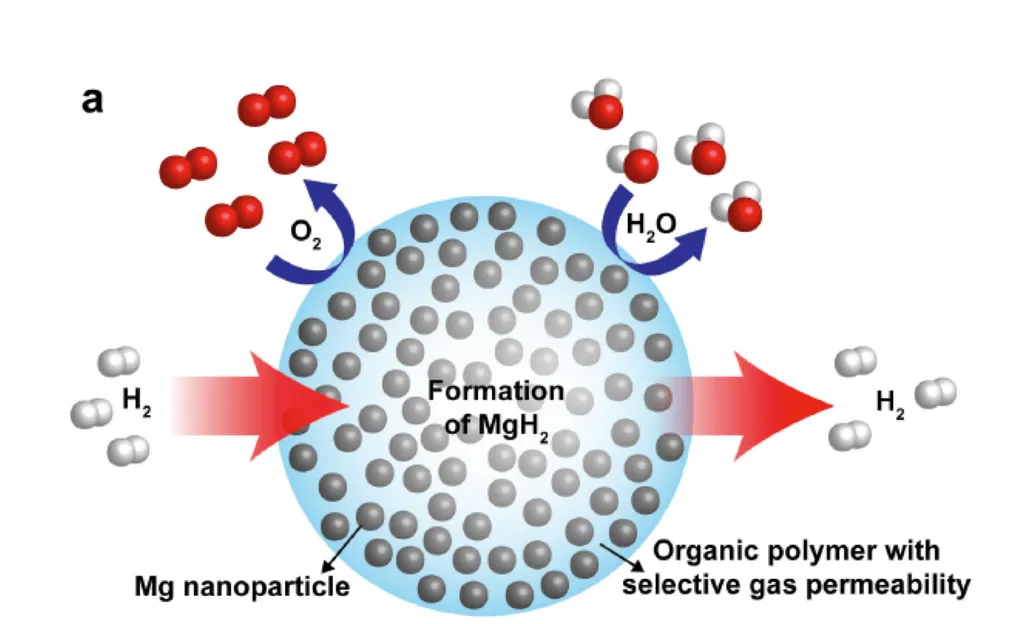
Magnesium hydride (MgH2) has long been touted as a promising candidate for solid-state hydrogen storage due to its high theoretical storage capacity. However, its practical applications have been hindered by the need for high temperatures and slow hydrogen uptake and release kinetics. The research team tackled these challenges by constructing TiO2 polyhedral frameworks uniformly distributed with V2O5, creating a catalyst that dramatically improves the hydrogen storage performance of magnesium.
The catalyst’s effectiveness lies in its ability to form metallic V and Ti, along with low-valent Ti- and V-based oxides during the hydrogenation and dehydrogenation processes. “The metallic V supported on TiO2 exhibits the lowest hydrogen adsorption energy, enabling superior catalytic performance over TiO2 and V2O5,” explained Hu. This results in a significant reduction in the peak dehydrogenation temperature of MgH2 to just 215°C, a substantial drop from the 320°C required for pristine MgH2. Additionally, the apparent activation energy is reduced from 139.50 kJ·mol−1 to 68.99 kJ·mol−1, making the process far more efficient.
One of the most striking findings is the catalyst’s ability to facilitate hydrogen dissociation without energy barriers. Electron migration from V toward TiO2 leads to charge accumulation around Ti and O atoms, shifting the V 3d-band center toward the Fermi level. This enhances the catalytic function of V’s d-electrons, enabling the V2O5/TiO2-catalyzed Mg to absorb 4.12 wt% H2 under an ultralow pressure of 1 bar at 25°C.
The implications for the energy sector are profound. Efficient hydrogen storage is a critical component in the transition to a hydrogen economy, and this research could pave the way for more practical and cost-effective hydrogen storage solutions. “This provides a new strategy for developing advanced Ti and V-based catalysts for mild-condition hydrogen storage of MgH2,” said Hu, highlighting the potential for further advancements in the field.
As the world continues to seek sustainable energy solutions, innovations like this catalyst could play a pivotal role in making hydrogen a more viable and accessible energy source. The research published in SusMat not only advances our understanding of hydrogen storage but also opens up new avenues for exploration and development in the energy sector.