
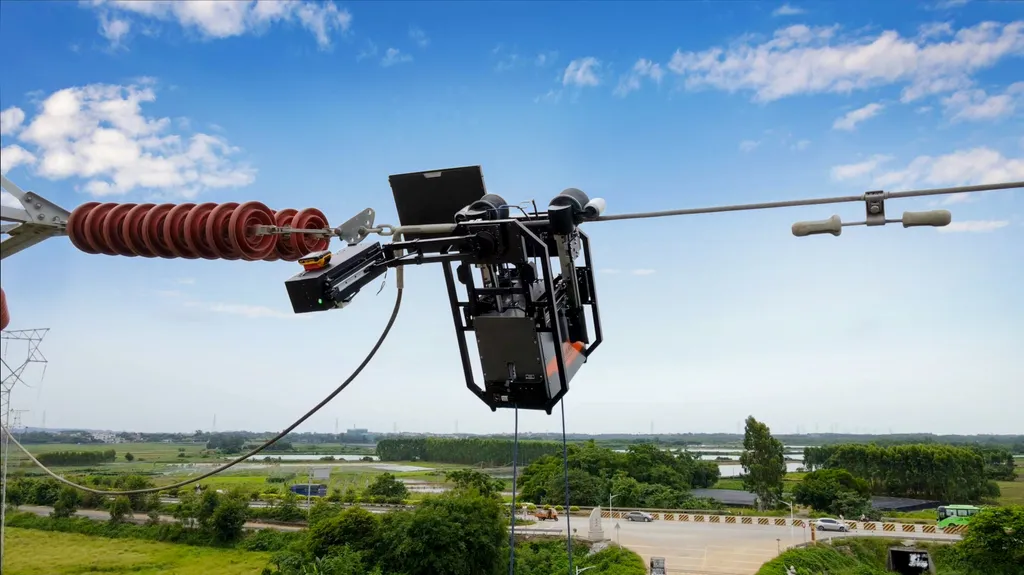
In the quest to enhance the safety and efficiency of transmission lines, a groundbreaking method for cable tension measurement has emerged, promising to revolutionize the energy sector. Led by Huang Zhiming of the Jiangmen Power Supply Bureau, Guangdong Power Grid Co., Ltd., this innovative approach combines cutting-edge visual image technology and deep learning to monitor cable tension with unprecedented accuracy.
Transmission lines are the lifelines of the energy sector, and the tension of their cable components is a critical factor in ensuring their safety and reliability. Traditional methods of measuring this tension have been plagued by limitations such as low accuracy, stringent environmental requirements, and the inability to monitor live lines. This has left a significant gap in the market for a universally applicable, high-precision measurement system.
The research, published in *Frontiers in Mechanical Engineering* (which translates to *Mechanical Engineering Frontiers* in English), utilizes Broadband Phase Motion Magnification to amplify the micro-vibrations of transmission line cables. This amplification allows for the enhancement of vibration images under environmental excitation. The study then employs a combined segmentation algorithm, using the U-Net network architecture and level set loss entropy, to accurately capture the centroid motion trajectory of the cables. This process enables the precise extraction of the vibration displacement time series, which is then analyzed using spectrum analysis to invert the self-vibration characteristic parameters of the components.
“The proposed method can precisely capture the micro-vibration signals induced by environmental excitation,” Huang explains. “This allows us to establish a non-contact, high-precision measurement system for cable-type components, providing a new technical pathway for intelligent monitoring during the construction and maintenance of transmission lines.”
The implications of this research for the energy sector are profound. By enabling accurate, non-contact tension measurement, this method can significantly enhance the safety and reliability of transmission lines. This, in turn, can lead to reduced maintenance costs, improved operational efficiency, and a lower risk of power outages. Moreover, the ability to monitor live lines opens up new possibilities for real-time monitoring and predictive maintenance, further enhancing the resilience of the energy grid.
As the energy sector continues to evolve, the need for intelligent, high-precision monitoring systems will only grow. This research by Huang Zhiming and his team represents a significant step forward in this field, offering a glimpse into the future of transmission line maintenance and a compelling example of how deep learning and image recognition can be harnessed to solve real-world problems.
In the words of Huang, “This method provides a new technical pathway for intelligent monitoring during the construction and maintenance of transmission lines.” With its potential to enhance safety, improve efficiency, and reduce costs, this innovative approach is set to make a significant impact on the energy sector.