
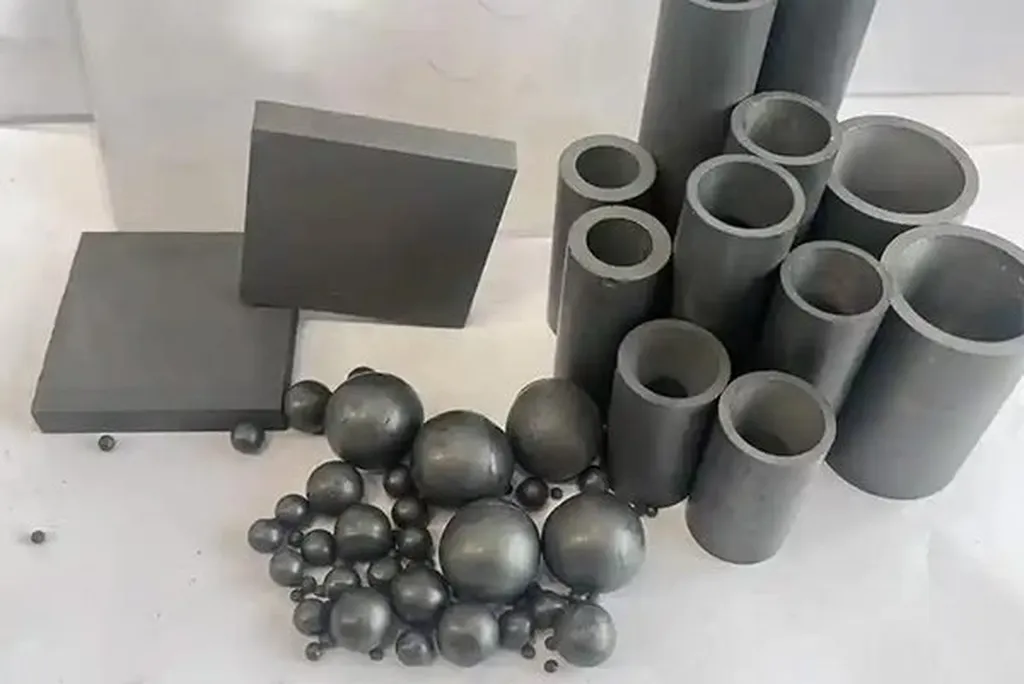
In the relentless pursuit of stronger, lighter, and more resilient materials, a team of researchers led by Yiyang Zhan from the School of Materials Science and Engineering at Henan University of Technology has made a significant breakthrough. Their work, published in the journal *Jin’gangshi yu moliao moju gongcheng* (translated as *Metallurgical and Materials Engineering*), focuses on enhancing the mechanical properties of boron carbide (B4C) ceramics, a material already renowned for its hardness and lightweight characteristics.
Boron carbide is already used in a variety of industrial applications, particularly in the energy sector, where its lightweight and robust nature make it ideal for protective components in nuclear reactors and ballistic armor. However, its single-phase structure has always posed a challenge, particularly in terms of fracture toughness. To address this, Zhan and his team explored the potential of diamond particles as a reinforcing phase, combined with silicon (Si) and titanium (Ti) as sintering assistants.
The team employed spark plasma sintering (SPS) technology, a method known for its ability to achieve rapid densification and fine microstructure control. By varying the sintering temperature between 1,400°C and 1,600°C, they observed significant changes in the densification behavior and interface structure of the B4C/diamond multiphase ceramics. “The sintering temperature plays a crucial role in the performance of these ceramics,” Zhan explained. “We found that at 1,550°C, the Si-Ti additive system promotes particle rearrangement and interface wetting through a liquid-phase sintering mechanism, effectively suppressing diamond graphitization.”
This optimal temperature resulted in ceramics with impressive mechanical properties: a relative density of 94.7%, a Vickers hardness of 35.6 GPa, a flexural strength of 361 MPa, and a fracture toughness of 6.43 MPa·m1/2. These properties make the material highly suitable for applications in lightweight protection fields, such as bulletproof plates and other ballistic ceramics.
The implications of this research extend beyond the immediate applications. As the energy sector continues to demand materials that can withstand extreme conditions while maintaining structural integrity, the development of enhanced B4C/diamond multiphase ceramics could pave the way for more efficient and reliable components. “This research not only improves the mechanical properties of B4C-based ceramics but also opens up new possibilities for their use in high-performance applications,” Zhan added.
The study’s findings highlight the potential for further advancements in the field of multiphase ceramics, particularly in the context of strengthening and toughening mechanisms. As researchers continue to explore the interplay between different phases and additives, the future of materials science looks increasingly promising. For professionals in the energy sector, this breakthrough could signal a shift towards more durable and efficient materials, ultimately driving innovation and progress in various industrial applications.