
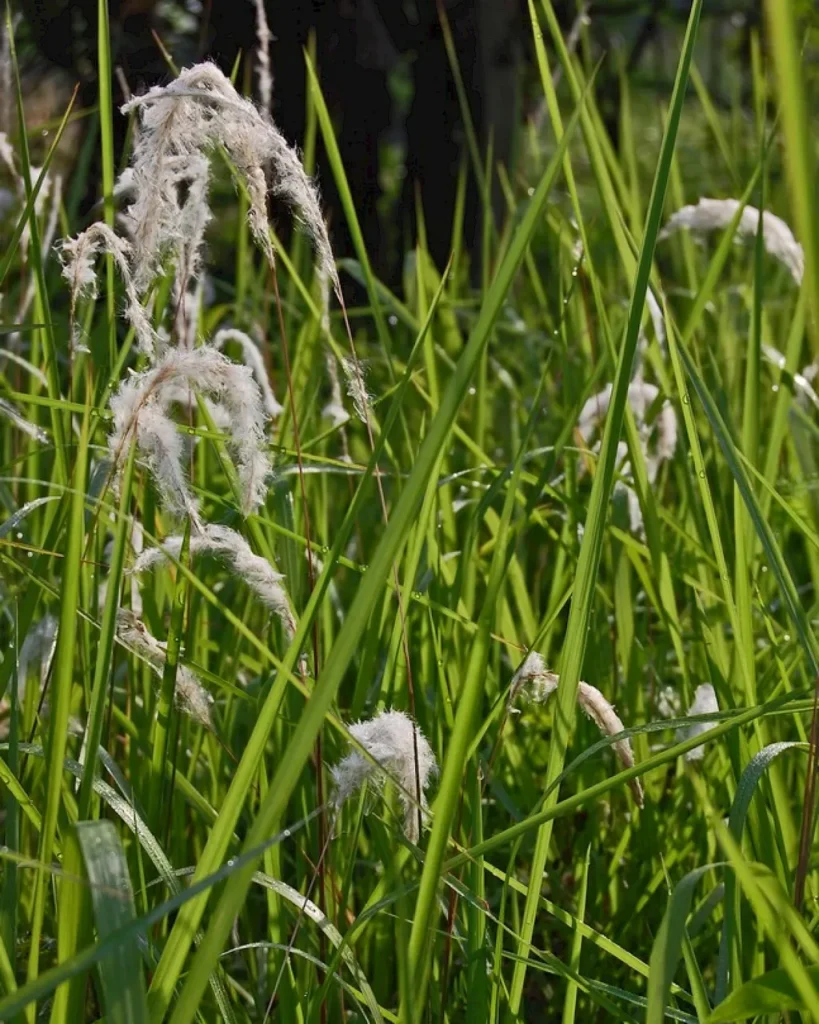
In the heart of materials science, a groundbreaking study has emerged, shedding light on the untapped potential of a humble plant fiber. Tchinda Yemlong Sorelle, a researcher from the Research Unit in Engineering of Industrial Systems and the Environment, has been delving into the properties of Imperata cylindrica (IC) fibers, a plant often overlooked in the quest for sustainable materials. Her work, published in the esteemed journal ‘Advances in Materials Science and Engineering’ (or ‘Advances in Materials Science and Engineering’ in English), is set to make waves in the construction and energy sectors.
Sorelle’s investigation focused on the physicochemical, thermal, and mechanical properties of IC fibers, extracted using varying concentrations of sodium hydroxide (NaOH). The results are promising, to say the least. “Chemical retting efficiently extracted IC fibers, especially at 6-wt% NaOH,” Sorelle explains. This process yielded fibers with an elliptical cross-section, a density of 2.211 g/cm³, and enhanced thermal stability when treated with silane.
The implications for the energy sector are significant. As the world grapples with the need for sustainable and efficient materials, IC fibers could emerge as a viable reinforcement in composite manufacturing. Their enhanced mechanical properties, particularly the high Young’s modulus, make them an attractive prospect for use in wind turbine blades, for instance. These blades require materials that are not only strong and lightweight but also resistant to the harsh environmental conditions they face.
Moreover, the study’s findings on the surface free energy of IC fibers suggest that silane treatment could reduce their hydrophilic properties. This is a crucial factor in the longevity and performance of materials used in energy generation and storage systems. As Sorelle puts it, “The plotting of wetting envelop helped to understand why it is difficult to obtain IC fibers using water retting.” This understanding could pave the way for more efficient extraction methods, further boosting the commercial viability of IC fibers.
The potential doesn’t stop at wind turbines. The construction industry is also eyeing sustainable materials to meet the growing demand for eco-friendly buildings. IC fibers, with their enhanced properties, could be the key to developing stronger, lighter, and more durable construction materials.
This research is a testament to the power of innovation in materials science. It opens up new avenues for exploration and application, pushing the boundaries of what’s possible in the energy and construction sectors. As we strive for a more sustainable future, studies like Sorelle’s remind us that the solutions we seek may lie in the most unexpected places. The humble Imperata cylindrica plant, once overlooked, now stands at the forefront of a materials revolution.