
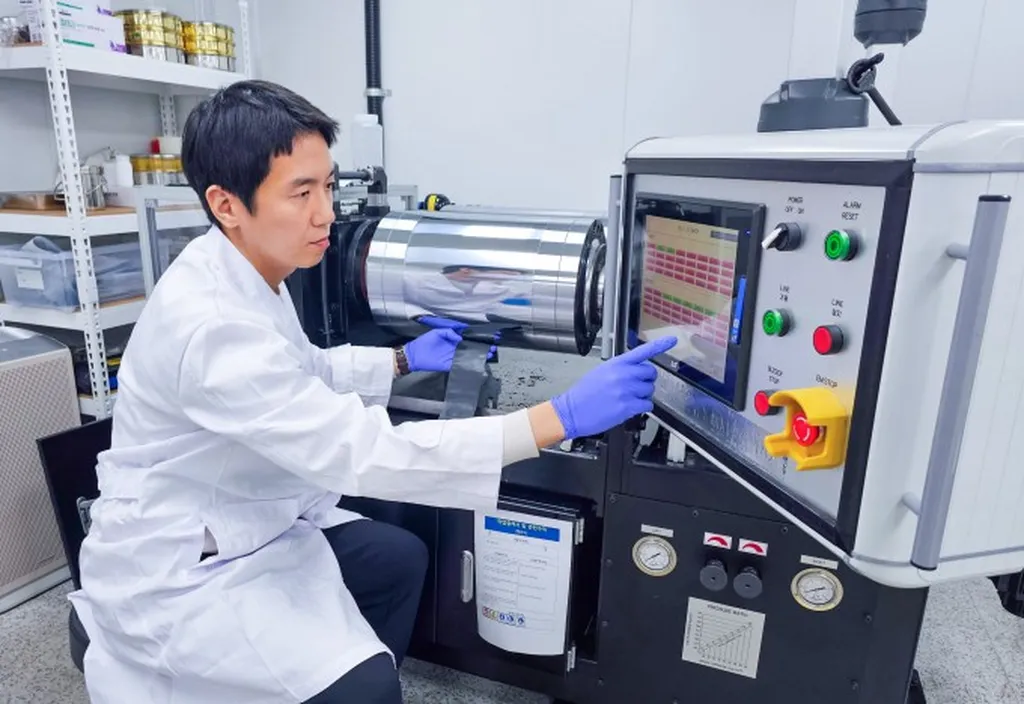
In a significant stride towards enhancing the sustainability and efficiency of lithium-metal batteries, researchers have introduced a novel approach to control lithium (Li) growth at the sub-nanoscale level. This innovation, led by Woo Hyeong Sim from the School of Mechanical Engineering and Department of Smart Fab. Technology at Sungkyunkwan University in Suwon, Republic of Korea, addresses one of the most pressing challenges in the energy sector: the limited storage capacity and safety risks associated with traditional graphite anodes.
The study, published in the journal Sustainable Materials (SusMat), which translates to Sustainable Materials in English, focuses on the development of a porous electrode-reinforced electric double-layer (PERE) structure. This structure features sub-nanoscale pores that concentrate the electric double layer (EDL) within the pore channels, enabling spontaneous Li+ accumulation and stable Li deposition. “By focusing the EDL within these sub-nanoscale pores, we can precisely regulate Li+ flux and promote stable Li growth,” Sim explained. “This approach solves a fundamental problem in battery technology without the need for additional anode active materials, significantly improving the sustainability of the battery.”
The practical implementation of the PERE structure in a battery with a LiFePO4 (LFP) cathode demonstrated impressive results. The PERE structure achieved a high specific capacity of 123 mAh g−1 for 250 cycles at 4.0 C. This breakthrough could have profound implications for the energy sector, particularly in the development of anodeless batteries. “Anodeless batteries are a promising avenue for next-generation energy storage solutions,” Sim noted. “Our research provides a critical step forward in making these batteries a viable option for commercial applications.”
The ability to control Li growth at the sub-nanoscale level opens up new possibilities for enhancing the performance and safety of lithium-metal batteries. This innovation could lead to more efficient and sustainable energy storage solutions, addressing the growing demand for reliable and high-capacity batteries in various applications, from electric vehicles to renewable energy storage systems.
As the energy sector continues to evolve, advancements in battery technology will play a pivotal role in shaping the future of sustainable energy. The research conducted by Sim and his team represents a significant leap forward in this field, offering a promising solution to one of the most persistent challenges in battery technology. With further development and commercialization, this innovation could revolutionize the way we store and utilize energy, paving the way for a more sustainable and energy-efficient future.